本文转载于Materials 2023, 16, 2953. https://doi.org/10.3390/ma16082953,不代表本网站赞同其观点和对其真实性负责,我们只作于阅读分享,非商业用途,如若侵权,请告知删除。
Esteban Padulles-Gaspar 1 , Esteban Padulles-Roig 2 , Guillermo Cabanes 2 , Román A. Pérez 3 , Javier Gil 3,* and Begoña M. Bosch 3,*
1Facultad de Odontología, Universitat Internacional de Catalunya, C/Josep Trueta s/n, 08195 Barcelona, Spain
2Department of Implantology, University of La Salle, Madrid, EDE, C7Gaminedes 11, 28023 Madrid, Spain
3Bioengineering Institute of Technology, Universitat Internacional de Catalunya, 08195 Barcelona, Spain
*Correspondence: 该Email地址已收到反垃圾邮件插件保护。要显示它您需要在浏览器中启用JavaScript。 (J.G.); 该Email地址已收到反垃圾邮件插件保护。要显示它您需要在浏览器中启用JavaScript。 (B.M.B.)
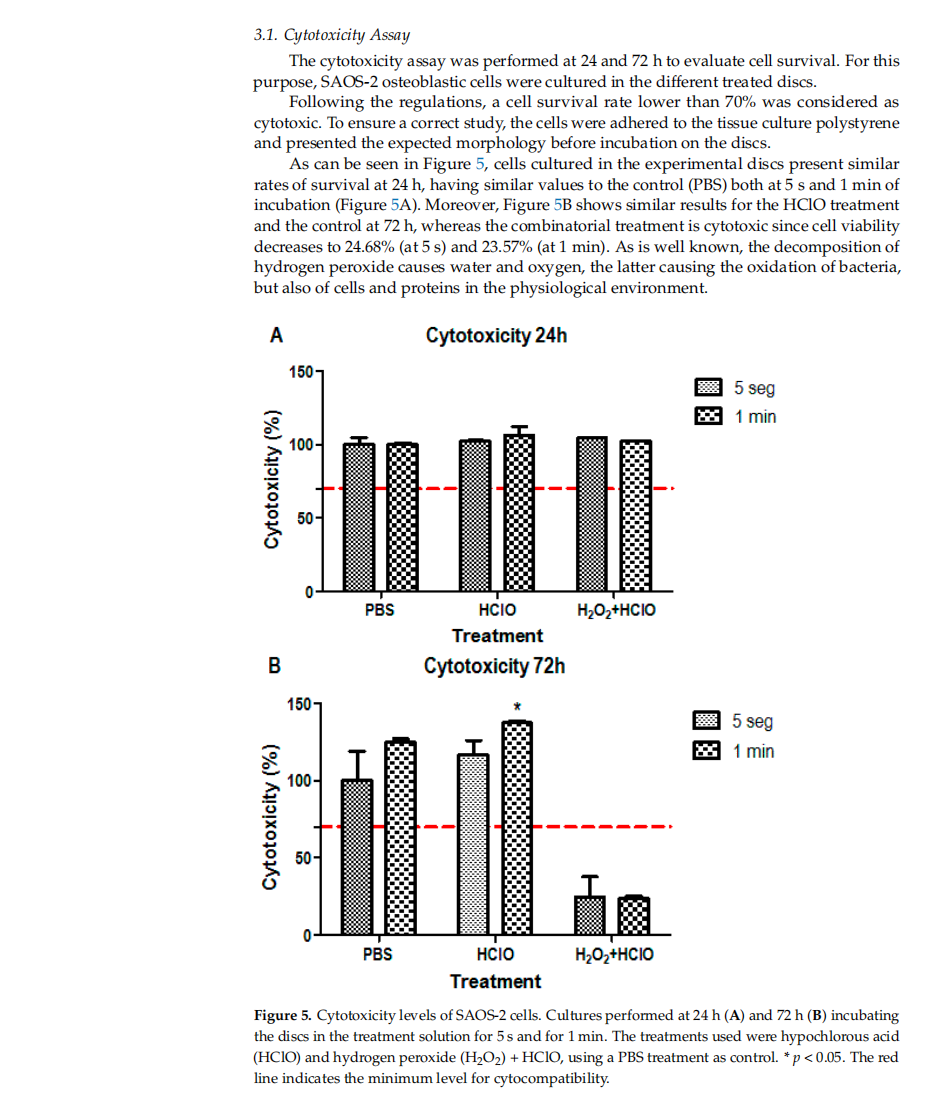
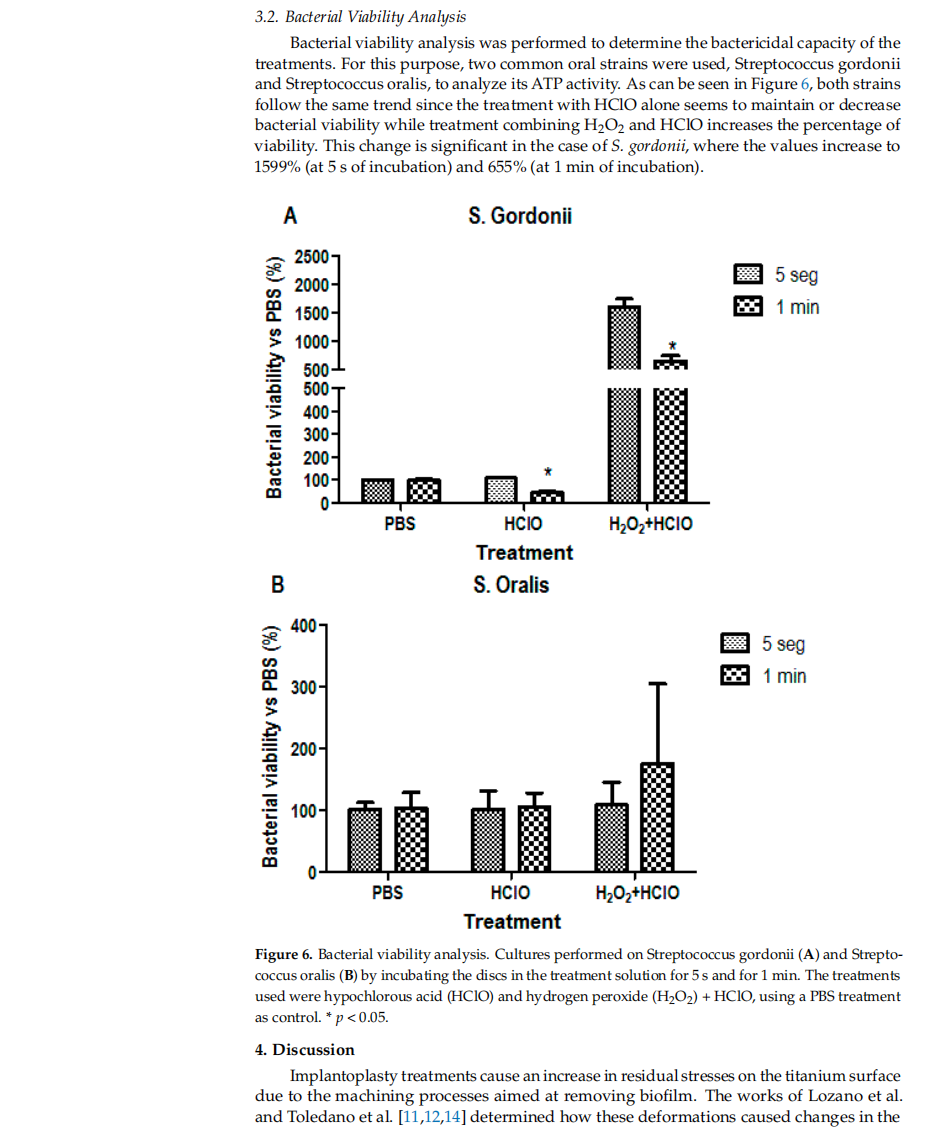
Abstract: One of the main problems in oral implantology today is peri-implantitis, which affects almost 20% of dental implants placed in patients. One of the most commonly used techniques to eliminate bacterial biofilm is the implantoplasty, that consists of the mechanical modification of the implant surface topography followed by treatments with chemical reagents for decontamination. In this study, the main aim is to evaluate the use of two different chemical treatments based on hypochlorous acid (HClO) and hydrogen peroxide (H2O2 ). For this purpose, 75 titanium grade 3 discs were treated with implantoplasty according to established protocols. Twenty-five discs were used as controls, 25 were treated with concentrated HClO and 25 were treated with concentrated HClO followed by treatment with 6% H2O2 . The roughness of the discs was determined using the interferometric process. Cytotoxicity with SaOs-2 osteoblastic cells was quantified at 24 and 72 h, whereas bacteria proliferation using S. gordonii and S. oralis bacteria was quantified at 5 s and 1 min of treatment. The results showed an increase in the roughness values, the control discs had an Ra of 0.33 µm and those treated with HClO and H2O2 reached 0.68 µm. Cytotoxicity was present at 72 h, together with a significant proliferation of bacteria. These biological and microbiological results can be attributed to the roughness produced by the chemical agents that triggered bacterial adsorption while inhibiting osteoblast adhesion. The results indicate that even if this treatment can decontaminate the titanium surface after implantation, the produced topography will generate an environment that will not favor long-term performance.
Keywords: hypochlorous acid; hydrogen peroxide; implantoplasty; periimplantitis
本文转载于Materials 2023, 16, 2953. https://doi.org/10.3390/ma16082953,不代表本网站赞同其观点和对其真实性负责,我们只作于阅读分享,非商业用途,如若侵权,请告知删除。