
伤口世界

- 星期五, 21 6月 2024
三种植物挥发油的化学成分、酪氨酸酶抑制能 力及抗氧化活性的研究---绪论(一)
摘 要
随着大气层中臭氧的逐渐减少,地球表面的紫外线强度不断增加。高强度的紫外照射会引起皮肤色素的过度沉着和皮肤功能的紊乱。因此研发有效的祛斑、美白护肤品一直是化妆品领域的热门之一。近年来,出于安全性方面的考虑,人们更愿意接受源自天然中草药的美白护肤产品。中国是一个植物物种多样的国家,有许多药食同源的植物挥发油在民间被广泛地应用于护肤品,但其是否具有祛斑、美白的功能,却鲜有研究。本论文选取了三种各具独特功能的本土植物挥发油(丁香花蕾油、香茅油和山苍子油),通过系列实验,为判断其是否具有成为美白护肤品成分的潜能提供科学依据。
主要内容包含以下几个方面:
1、优化了提取山苍子油、丁香花蕾油和香茅油的提取工艺,并用气质联用技术鉴定了三种挥发油的主要成分。鉴定出山苍子油中的19种化学成分,占整个挥发油组分的 92.4%。主要成分有柠檬醛(57.4%),柠檬烯(8.1%),芳樟醇(5.2%),B-月桂烯(4.7%),α-松油醇(3.9%),β-蒎烯(2.7%)和a-蒎烯(1.9%);鉴定出丁香花蕾油中的 10种成分,占整个挥发油的94.8%。主要成分有丁香酚(76.8%),乙酸丁香酯(9.5%)和B-石竹烯(6.0%);鉴定出香茅油中的 17 种成分,占整个挥发油的 93.5%。主要成分有香茅醛(33.9%),香叶醇(18.1%),和香茅醇(11.1%)。
2、通过酪氨酸酶抑制试验来评价三种挥发油及其主要成分对酪氨酸酶的抑制效果。结果表明山苍子油和其主要成分柠檬醛对酪氨酸酶单酚酶和二酚酶活性有抑制能力,对酪氨酸酶二酚酶的抑制能力强于酪氨酸酶单酚酶,且动力学结果表明柠檬醛对酪氨酸酶是非竞争性抑制作用。丁香花蕾油和丁香酚对酪氨酸酶单酚酶具有一定的抑制作用,但是对酪氨酸酶二酚酶没有表现出任何抑制作用。而香茅油及其主要成分对酪氨酸酶没有抑制作用。
3、分别研究了山苍子油、香茅油、丁香花蕾油和其主要成分的抗氧化活性。
结果表明丁香花蕾油具有最强的自由基清除能力(超阴离子的ICo值为58g/mL;ABTS的ICso值为8.5μg/mL)和强的抑制脂质过氧化的能力;香茅油的自由基清除能力和抑制脂质过氧化的能力低于丁香花蕾油(超氧阴离子的ICso值为150 μg/mL;ABTS*的ICso值为 500μg/mL)。山苍子油的自由基清除能力最低(超氧阴离子的ICso值为10.2mg/mL;ABTS 的ICso值为 17.75 mg/mL)。
4、为了探讨山苍子油、丁香花蕾油和香茅油分别对 UV-TiO2-NO,体系导致的蛋白质氧化和酪氨酸硝化损伤的抑制作用,将牛血清蛋白作为模型蛋白进行体外试验,采用免疫印迹法测定牛血清白蛋白的氧化和酪氨酸硝化。结果表明丁香花蕾油、香茅油和山苍子油对UV-TiO,-NO,-催化的蛋白质氧化和酪氨酸硝化都有较强的抑制效果且呈剂量依耐性。
关键词:挥发油,酪氨酸酶,抗氧化,纳米二氧化钛,蛋白质氧化,蛋白质酪氨酸硝化
Abstract
Ultraviolet (UV) radiation on the surface of the earth is certainly increasing as a result of the depletion of stratospheric ozone. High-intensity or accumulated UV radiation provokes many hyperpigmentation disorders, which are of particular concern to women as well as men, In recent years, the study of traditional herbal medicines for skin-protecting and skin-lighting has become a hot spot in the cosmetics field, due to various safety concerns and interesting largely unexplored sources. In this dissertation. the main objective was to investigate the potential usage of clove oil , citronella oil and Litsea cubeba oil as natural sources of tyrosinase inhibitor, antioxidant, and protectionprotein against UVTiO,-NO2- induced protein oxidation and tyrosine nitration in jury The main results are as follows:
1. The clove oil, citronella oil and Litsea cubeba oil extracted by hydrodistillation, showed light yellow in color. The total of 10 compounds was identified by GC-MS in the clove oil, accounting for 94.8% of the total oil. The main components were eugenol(76.8%), followed by eugenyl acetate (9.5%) and β-caryophyllene (6.0%). Essential oil from Cymbopogon goeringii leaves was also analyzed by GC-MS, resulted in the identification of 17 compounds representing 93.5% of the oil. Citronellal (33.9%),geraniol (18.1%), and citronellol (11.1%) were the main compounds. GC-MS analyses of Litsea cubeba oil led to identification of 19 different compounds, accounting for 92.4%of the total oil. The main components were citral representing 57.4% of the total amount of oil extracted, follow by limonene(8.1%),linalool (5.2%),β-myrcene (4.7%),a-terpineol (3.9%),β-pinene(2.7%) and a-pinene(1.9%%).
2. Tyrosinase inhibitory assay was used to evaluate whether the three essential oilsand their main components possessed potential inhibitory effect on tyrosinase. The results show that Litsea cubeba oil and citral exhibited inhibitory effect on monophenolase and diphenolase activity of tyrosinase. The inhibitory effect of Litseacubeba oil and citral on diphenolase activity was stronger than monophenolase activity oftyrosinase. The inhibition pattern of mushroom tyrosinase by citral was determined byLineweaver-Burk polt analysis. The results demonstrated that citral was anoncompetition tyrosinase inhibitor, Clove oil and eugenol exhibited some inhibitoryeffect on monophenolase activity of` tyrosinase, but not show any inhibitory effect on diphenolase activity of tyrisinase. Citronella oil and their main components didn'texhibited any inhibitory effect.
3. In order to determine whether the three essential oils and their main components had antioxidant activity, ABTS cation radical scavenging assay, superoxide anion radicalscavenging assay and lipid peroxidation assay were carried out. Clove oil exhibited prominent radical scavenging activities (ICso: 58 μg/ mL for O2 and 8.5 ug/ mL for ABTS*) and strong inhibitory effect on lipid peroxidation, whilst citronella oil showedweaker antioxidative activities (ICso: 150 μg/ mL for O, and 500 μg/ mL for ABTS )and lipid peroxidation inhibitory efficiency. Litsea cubeba oil exhibited the lowest anti-oxidative activities (ICso: 17.75 mg/mL for ABTS , 10.2 mg/mL, for O, ).
4. In order to investigate inhibitory effects of essential oils to UV-TiO,-NOzinduced protein oxidation and protein tyrosine nitration injury, bovine serum albumin(BSA) were used as model protein, inhibition were followed by $DS-PAGE and Western blotting methods. The results showed that clove oil, citronella oil and Litsea cubeba oil exhibited satisfactory protective effects and revealed dose-dependence in protecting BSAagainst UV - TiO, - NO,` induced protein oxidation and tyrosine nitration injury.
Keywords: essential oil, tyrosinase, antioxidant, nano TiO2, protein oxidation, tyrosine nitration
- 星期四, 20 6月 2024
红缨合耳菊防晒成分的提取及其性能
徐春涛1,马飞2,纪红兵2
(1中山职业技术学院信息工程学院,2广东中山528404:中山大学化学与化学工程学院,广东广州510275)
摘要:红缨合耳菊属于西藏特有的菊科植物,其有潜在的美白及防晒效果。本文选择水、正已烷、乙醚和乙醉为溶剂,考察 4种草取溶剂提取液的紫外吸收效果,并结合最佳革取溶剂,考察不同提取工艺对红撄合耳莉防晒成分提取率的影响。结果表明,采用超声波提取工艺,以乙醇为萃取溶剂效果最佳,整体提取率为27%。采用气质联用仪(GC-MS)对红缨合耳菊提取液成分进行分析,研究发现提取物中含有较多的共双体系化合物,这些化合物分别是 3-亚甲基-6-(1-甲基乙基)环已烯、菜烯、环已烯等,带有共轭双键体系的化合物具有较强的紫外吸收效果,将红缨合耳菊提取液制成防晒霜,发现含有质量分数2.5%的红缨合耳菊提取物防晒霜在UVB(290~320nm)段禁外线区具有很好的禁外线防护功能,平均吸光度值为1.95。
关键调:红缨合耳药:防晒剂:防晒霜:提取物:紫外线中图分类号:TO658.2文献标志码:
A文章编号:1000-6613(2017)04-1429-05
DO1:10.16085/.issn.1000-6613.2017.04.037
Sunsereen ingredients of synotis erythopappa(Bur.et Franch)C. Jeffey et Y.L.Chen and its application in sun cream
XU Chuntao1, MA Fei2 . .JI Hongbing2
('College of Information Engineering, Zhongshan Polytechnic, Zhongshan 528404. China: 'School of Chemistry and
Chemical Engineering, Sun Yat-sen University, Guangzhou 510275,Guangdong. China)
Abstract: Synotis erythopappa ( Bur.et Franch) C. Jeffeyet Y. L Chen, as an endemic compositae in Tibete. has potential benifits in whitening and sun blocking. In this paper, four different solvents
(water, hexane, aether and alcohol) were used to extract the plant, respectively. The extraction was investigated by testing actual UV absorbtion value. Using the best extract solvent, different extract
technologies were used to evaluate the effectiveness of the extraction. The results showed thatethanol, as the extract solvent and combing with ultrasonic extraction technology, the exctraction rate was up to 27%. Gas chromatographymass spectrometer (GC-MS ) was used to analyze the sun block components from extract solvent. It was found that 3-methylenc-6-( l-methyl ethyl) cyclohexene, cyclohexene,
pinene, myrcene, with conjugated double bonds could absorb ultraviolet. With the synotis erythopappa(Bur.et Franch)C. Jeffey et Y.L. Chen extract as a sunscreen ingredient, it was found
sunscreen with 2.5% mass fraction of synotis erythopappa (Bur.et Franch) C. Jeffey et YL.Chen had very good UV protection in UVB (290- 320nm) ultraviolet region, and the average absorbance value
was 1.95.
Key words: synotis erythopappa( Bur.et Franch )C. Jeffey ct Y .L. Chen: sunscreen: sunscreen cosmetics; extracts; ultraviolet rays

- 星期三, 19 6月 2024
西藏红缨合耳菊对B16细胞的影响(三)
3.1 前言
皮肤黑色素形成机理:存在于黑色素细胞组织中的酪氨酸在酪氨酸酶等酶的作用下经多巴、多巴醌、多巴色素、二羟基哚等中间体逐步转化为真黑色素,进而黑色素细胞组织将黑色素转移到表皮基底层细胞中,随着细胞的新陈代谢而被带到角质层中,最后随角质化细胞脱落。但是由于受紫外线、遗传、内分泌、炎症介质、饮食不当等因素的影响,黑色素代谢异常,皮肤黑素过快增长和分布不均,就会造成局部皮肤过黑及色素沉着,表现为黄褐斑、雀斑和炎症后色素沉着等。从国外文献来看,评价美白化妆品的功效主要以检测施加美白化妆品有效成分后,是否抑制酪氨酸酶活性为主要手段。目前,随着人们对祛斑美白药物需求的不断增加,越来越多的治疗色素沉着性疾病的药物投人到临床使用,其中不少药物确有良效,但使用中也出现了大量的不良反应导致严重的后果。
而将药物直接加入到细胞中观察药物对细胞的影响,则是一种最为直接的手段。由于黑素瘤细胞具有能够多次传代、生长快和培养条件相对较低等优点,成为筛选美白剂时的首选细胞。20世纪70年代初,Eisinger成功培养出正常黑色素瘤细胞,越来越多地采用人体正常黑色素细胞的体外培养技术。为此,我们基于实验室黑色素细胞培养,选用国内外常用B16黑素瘤细胞作为受试细胞,对红缨合耳菊的疗效和安全性的评价,为临床提供资料。
3.2材料与仪器
3.2.1 材料
红缨合耳菊提取物 自制
RPMI-1640培养基 美国 HyClone 公司
小牛血清 美国 HyClone 公司
胰蛋白酶 美国 HyClone 公司
L-多巴 美国 Sigma公司
Triton X-100 美国 Sigma公司
磷酸氢二钠 广州市化学试剂有限公司
磷酸二氢钾 广州市化学试剂有限公司
氯化钠 广州市化学试剂有限公司
氯化钾 广州市化学试剂有限公司
二甲基亚砜 广州市化学试剂有限公司
熊果苷 美国 Sigma公司
3.2.2 仪器
CJT-12超净工作台 北京昌平长城空气净化公司
DG-5031型酶联免疫检测仪 杭州博特仪器有限公司
CH2-TKC-3倒置显微镜 广东光学仪器有限公司
HZQ-F全温振荡培养 上海苏坤仪器有限公司
灭菌锅 上海苏坤仪器有限公司
3.3 实验方法
3.3.1细胞的培养及接种
无菌条件下,将B16细胞接种于含10%(体积分数)的小牛血清的RPMI1640培养基的培养瓶中,在5%(体积分数)COz培养箱中培养,每3d用0.25%胰酶消化传代一次。待细胞生长到对数期,用PBS洗涤,0.25%酶消化,细胞计数板计数。电镜观察细胞形态变化。调整细胞5X10个/mL。接种于96孔板中,每孔100L,置孵箱中孵育24h后,弃上清液,添加待测药物,每组药物最终质量浓度分别为320mg/L、160 mg/L、80 mg/L、40 mg/L、20 mg儿、10 mg/L、5 mg/L。每一浓度设5个孔,对照组不加药物,代之同量维持液,空白孔不接种细胞。37℃5%的CO,孵箱中孵育 72 h。
3.3.2 倒置显微镜观察
收集对数生长期细胞接种于6孔培养板中,每孔2ml。培养过夜后,加入不同浓度的药液100L,对照组加入同体积的RPMI-1640液。作用不同的时间后,置倒置显微镜下观察,照相并记录实验结果。
3.3.3黑色素细胞增殖抑制率测定
四甲基偶氮唑蓝比色法(MTT法):药物作用72h后,每孔加入5g/LMTT溶液10μL,4h后弃上清液,每孔加入 DMSO 100μL,振荡 10min 左右,在酶标仪上检测各孔吸光度值,以空白孔调零,波长为490nm。

3.4 实验结果与讨论
3.4.1 显微镜观察
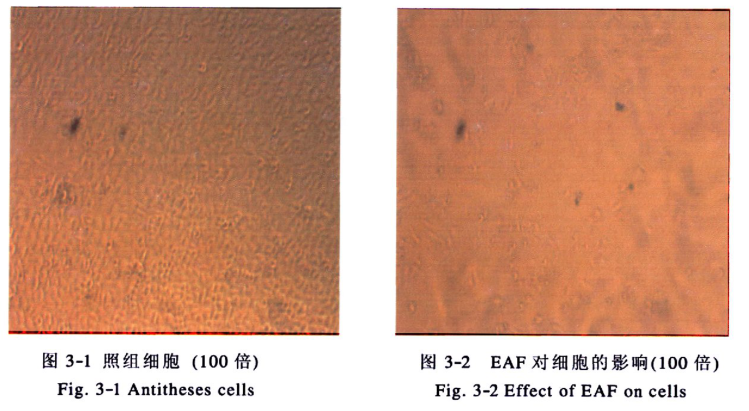
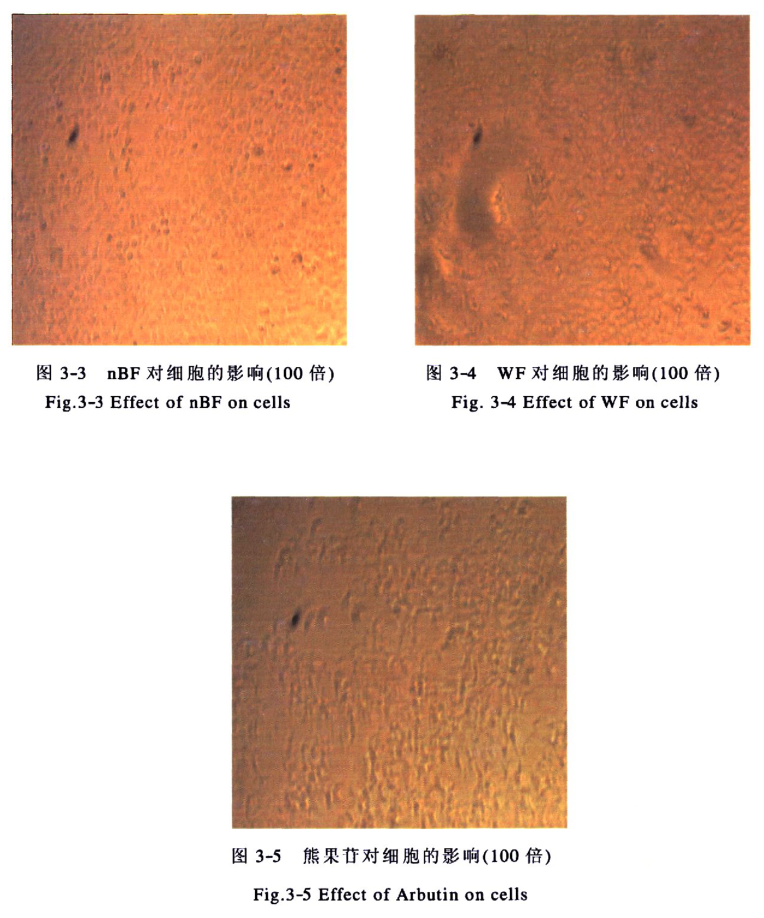
将红缨合耳菊各部分加入培养液(终浓度为320g/mL),作用于细胞后,我们发现细胞的形态明显发生变化。对照组细胞生长良好(见图3-1);加入EAF部分后,细胞树突减,细胞个数减少,变大(见图3-2);加入nBF部分后发现细胞未发生明显的变化,生长良好(见图3-3):加入WF部分后细胞生长状态稍差,不如对照组及nBF部分组(见图3-4):加入熊果苷组后能明显看到细胞树减少,细胞融合在一起(见图3-5)。
3.4.2 黑色素细胞增值率
红缨合耳菊可抑制黑色素细胞的生长,其效果与浓度相关,随着浓度的增加对细胞生长的抑制能力增加,320g/mL的熊果苷、EAF部分、nBF部分、WF部分对细胞生长的抑制率分别可达到42.57%、65.67%、10.24%、9.75%(表 3-1)。
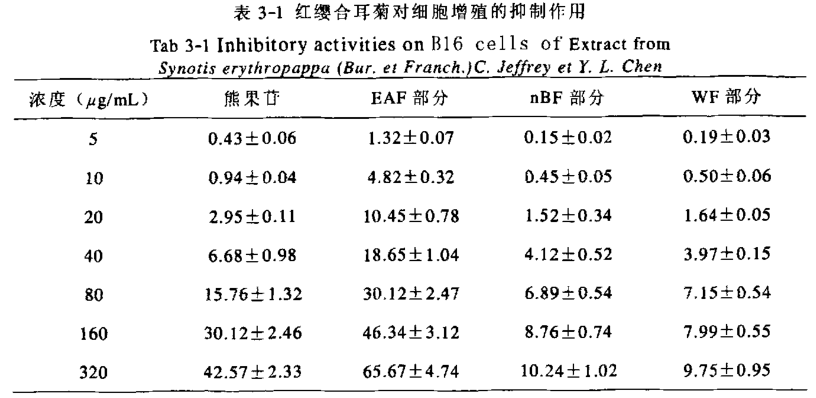
实验结果表明,受试物对黑色素细胞的毒性作用大小依次是:乙酸乙酯萃取部分>熊果苷>正丁醇萃取部分>水溶部分。熊果苷是常用的化妆品美白添加剂,其美白作用明显,人们对其美白作用的重视超过了对其细胞毒性的关注。然而许多研究均已表明熊果苷具有比较强的细胞毒性。我们的实验结果也对其进行了验证,当浓度为320μg/mL时,对细胞增殖的抑制作用可达到42.57%,可见其毒性较高。红缨合耳菊提取物的测试结果表明乙酸乙酯萃取部分对细胞的毒性比较大,而正丁醇萃取部分及水溶部分则对黑色素细胞的增殖抑制作用较小,浓度在320μg/mL时,其对细胞增殖的抑制率在10%左右,即这两部分有很小的细胞毒性。因此从健康方面考虑,在研究开发美白化妆品添加剂时,若使用熊果苷之类具有细胞毒性的物质,一定要在安全剂量范围内使用,而红缨合耳菊的正丁醇及水溶部分则可作为一种新型的天然植物提取物,基本没有剂量方面的限制。
3.5 本章小结
1.通过对细胞形态的观察,我们发现加入红缨合耳菊提取物及熊果苷后,细胞形态均发生变化,其中以EAF部分对细胞的影响最大。
2.测试了红缨合耳菊提取物对细胞生长的抑制率,研究发现,EAF部分对细胞的致死率最大,在320μg/mL时可达到65.67%,而nBF、WF部分分别为10.24、9.
未完待续……

- 星期二, 18 6月 2024
西藏红缨合耳菊对酪氨酸酶抑制作用(二)
2.1 前言
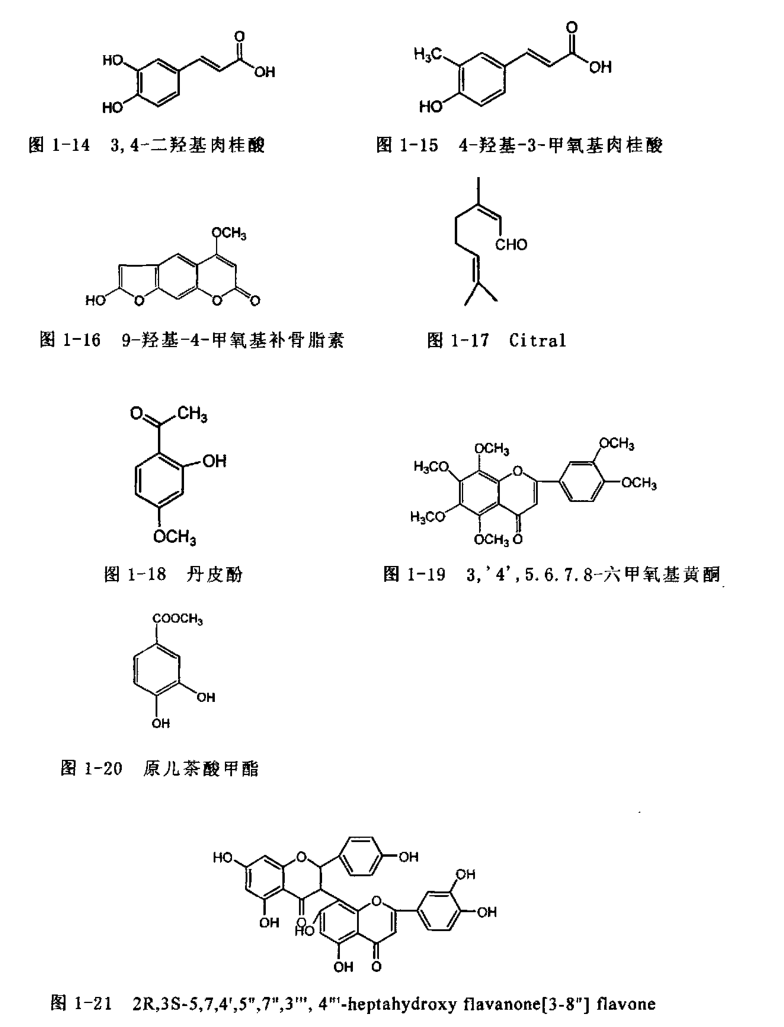
酪氨酸酶(EC1.14.18.1)又称多酚氧化酶,它广泛存在于动植物体和人体内,是生物体合成黑色素的关键酶。酪氨酸酶是一种含铜的金属酶,每一个亚基含两个金属铜离子,两个铜离子分别与蛋白质分子中组氨酸结合,另有一个内源桥基将两个铜离子联系在一起,构成酪氨酸酶催化氧化反应活性中心,能够催化单酚羟化成二酚(单酚酶活性),并把二酚氧化成(二酚酶活性),醌在非酶促条件下形成最终的反应产物黑色素。反应过程如下:
皮肤黑色素细胞组织将黑色素转移到表皮基底层细胞中,随着细胞的新陈代谢而被带到角质层中,最后随角化细胞脱落。若皮肤黑色素过速增长和分布不均时,就会造成局部皮肤过黑及色素沉着,出现皮肤黑色素。皮肤内黑色素是由黑色素细胞生成的,其过程是酪氨酸在酪氨酸酶的作用下生成多巴和多巴醌,多巴再经多巴色素、最终合成黑色素,然后被分泌到周围的角肮细胞中。其中黑色素的形成过程中,酪氨酸酶起了关键酶的作用,黑色素产生的多少与酪氨酸酶的活性有直接的关系。因此,皮肤美白剂就是通过作用于皮肤黑色素生成,代谢过程中,抑制黑色素生成且符合安全规范的物质。由于酪氨酸酶分别作用于酪氨酸转化为和加两个过程,目前的皮肤美白剂就是通过抑制酪氨酸酶活性或者阻断酪氨酸生成黑色素的氧化途径,从而减少黑色素的生成达到美白皮肤的效果,
传统的皮肤美白剂,往往采用化学性物质,如过氧化氢、化氨基汞以及各种酚类衍生化合物。这些化合物能使黑色素组织迅速瓦解,达到快速美白之功效。但因其对皮肤腐蚀性、细胞毒性和过敏性等因素,具有极大的危险性,在许多因家的卫生规范中,已被禁用。目前要求的皮肤美白剂,不但美白效果有效且无毒副作用,一般源自天然植物提取物,如熊果昔、曲酸及其衍生物、维生素及其衍生物、甘草黄酮、以及中草药提取物等。
西藏红缨合耳菊(Synotis erythropappa(Bur.et Franch.)C.Jeffrey et Y.L.Chen)为菊科(Composilae)植物,属西藏特有植物。产于西藏东南部,西藏当地女性将红缨合耳菊捣碎、烧成灰等后,敷在皮肤表面用于皮肤保养及紫外线防护。美白剂对酪氨酸酶活性的抑制率大小成为衡量这类物质美白效果的重要依据本文通过研究西藏红缨合耳菊70%乙醇提取物及其石油醚、乙酸乙酯、正丁醇萃取部分及水溶部分对酪氨酸酶的抑制作用,并以常用的美白药物熊果苷作为阳性对照,探讨其是否具有抑制酪氨酸酶的效果,为红缨合耳菊在美白化妆品方面的开发利用提供依据。
2.2 材料与仪器
2.2.1 材料
红缨合耳菊 自採
酪氨酸 美国 Sigma 公司
酪氨酸酶 美国 Sigma 公司
L-多巴 美国 Sigma 公司
磷酸氢二钠 广州市化学试剂有限公司
磷酸二氢钠 广州市化学试剂有限公司
二甲基亚砜 广州市化学试剂有限公司
无水乙醇 广州市化学试剂有限公司
石油醚 广州市化学试剂有限公司
正丁醇 广州市化学试剂有限公司
乙酸乙酯 广州市化学试剂有限公司
熊果苷 美国Sigma公司
2.2.2 仪器
FA2104型电子天平(0.0001g) 日本岛津
TU-1901双光束紫外可见分光光度计 北京普析通用
HWS型智能恒温恒湿箱 上海苏坤仪器有限公司
移液枪 上海大龙精密仪器有限公司
旋转蒸发仪 上海金叶仪器有限公司
PH 计 上海精密仪器
粉碎机 广州仪器有限公司
搅拌器 广州仪器有限公司
2.3 实验方法
2.3.1 提取分离方法
将红缨合耳菊在50℃下烘干后粉碎,用70%的乙醇浸提红缨合耳菊粉末(70%乙醇体积:红缨合耳菊质量=15:1),在机械搅拌器搅拌、室温下浸提一周。浸提后用旋转蒸发仪在50℃下将提取液浓缩至无乙醇后依次用石油醚、乙酸乙酯、正丁醇萃取。所得四部分溶液用旋转蒸发仪在50℃缩得到浸膏,浸在50℃下真空干燥。观察各萃取部分性状并计算各部分提取率。
2.3.2酪氨酸酶活性抑制的测定
参考Y.B.Ryu等及邓湘庆等的方法并略作修改,先加入0.1m含不同浓度的抑制剂于比色杯中,再加进2.8mL预先在30℃恒温水浴保温的底物溶液,然后加入0.1mL酪氨酸酶水溶液,即刻充分混匀,在30℃恒温条件下,测定波长为475nm的光密度值,由其随时间的增长直线的斜率计算出酶的活力,酶抑制实验平行做三次。测定单酚酶活力所用的底物为2mmol/LTyr,酶的终浓度为40μg/mL:二酚酶所用底物为0.5 mmol/L L-DOPA,酶的终浓度为 8 μg/mL。
2.3.3酪氨酸酶抑制类型的测定
参考酪氨酸酶活性抑制的测定,在测活体系中,固定酶的浓度,改变底物L-DOPA的浓度,测定不同浓度提取物对酶活力的影响,以Lineweaver-Burk 双倒数作图,比较酶催化反应的动力学参数,包括表观米氏常数(Km)和最大反应速度(Vm)的变化来判断抑制类型。
2.4 实验结果
2.4.1 红缨合耳菊的提取分离
中草药的有效成分的提取方法很多,常见的有溶剂萃取法、沉淀法、盐析法、透析法、结晶、重结晶和分步结晶法等方法。但最常见的,用得最广的,效果较好的还是溶剂萃取法,溶剂进入药材组织中,溶解其中的化学成分,并将其从组织中逐渐提出的过程。本实验对红缨合耳菊的处理采用溶剂萃取法。
提取时提取液的颜色随浸提时长变深最终为深红褐色,提取物经减压旋转蒸发后得到具有芳香味的粘稠状、深红褐色物质。将其水溶后分别用石油醚、乙酸乙酯、正丁醇进行萃取,初步分离后各萃取部分的提取率及性状见表2-1。
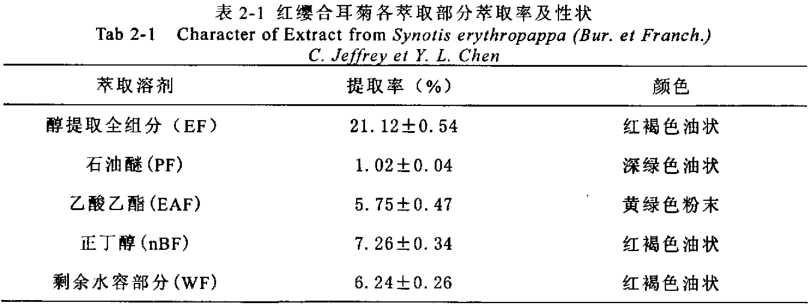
在实验过程中每次的浸提过程中得到的各萃取部分的性状基本一致,但是各部分萃取率稍微有些偏差。在使用旋转蒸发仪浓缩总提取物时一定要蒸到体积小于原加水的体积量为宜,若还有残留的乙醇则在萃取时可能使萃取产生偏差。在浓缩及真空干燥时温度不易超过60℃,温度过高可能会导致一些有效成分发生变化。
2.4.2对酪氨酸酶单酚酶活力的影响
以L-Tyr为底物,测试各部分对酪氨酸酶单酚酶活力的影响,结果见表2-2。
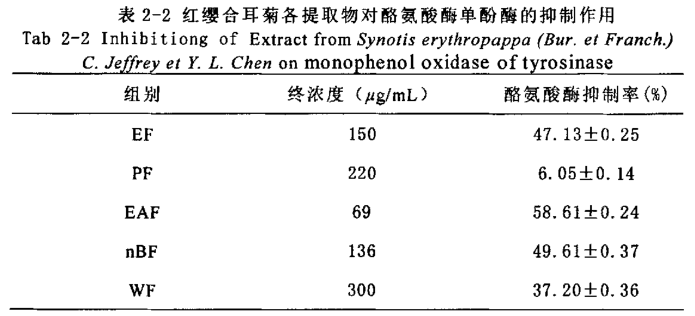
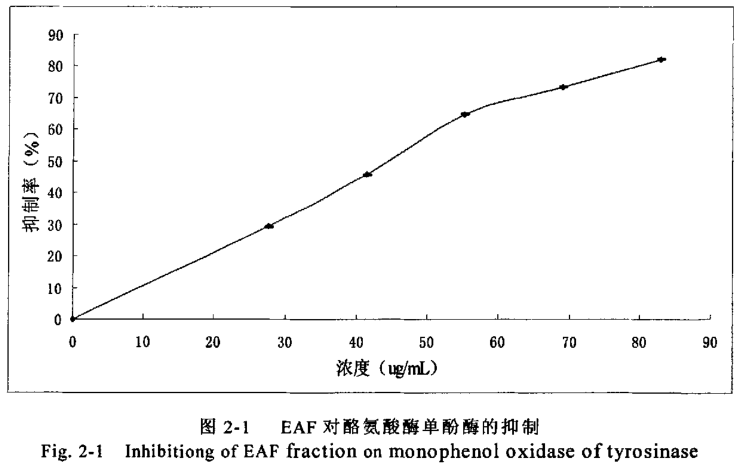
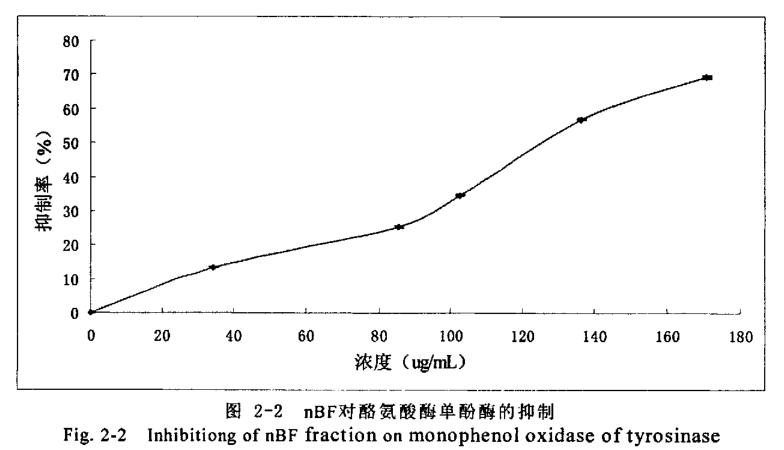
实验中醇提取物及其石油醚、水溶部分ICso均超过150g/mL,而乙酸乙酯正丁醇部分ICso均小于150μg/mL,提示了EAF、nBF部分富集了西藏红缨合耳菊抑制酪氨酸酶单酚酶的主要有效组分。我们进一步分别EAF、nBF部分对酪氨酸酶的抑制作用进行了研究,研究结果(见图2-1、2-2)表明抑制率随提取物的浓度的增加而变大,EAF、nBF部分的IC50分别为57.8、140g/mL。
2.4.3对酪氨酸酶单酚酶活性的迟滞影响
酪氨酸酶单酚酶的催化特征有迟滞过程,催化酪氨酸羟基化过程见图2-3、图2-4,随着抑制剂浓度的增大酪氨酸酶的稳态活力(直线部分的斜率)逐渐下降并伴随着迟滞时间的延长。
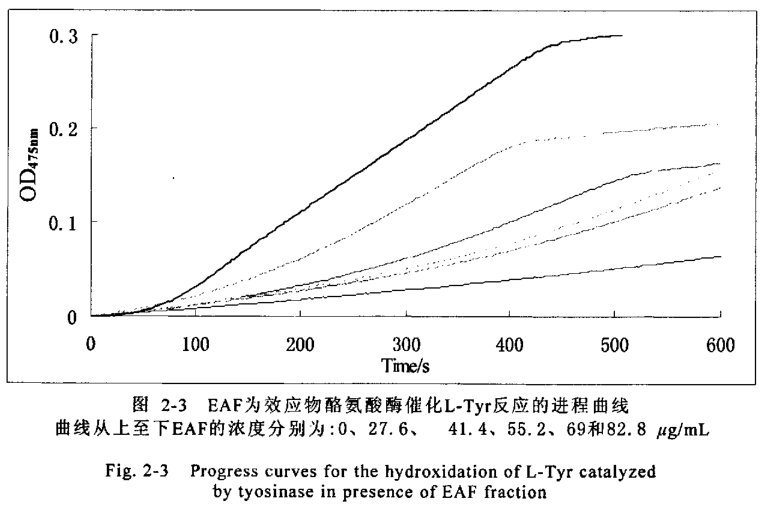
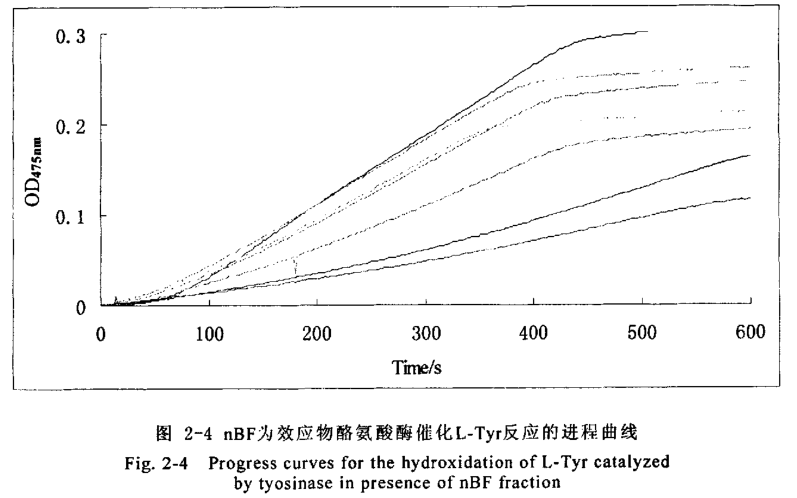
曲线从上至下nBF的浓度分别为:0、34.1、51.2、85.4、102.5、136.6和170.8 g/mL82.8μg/mLEAF部分使得酶的稳态活力下降了
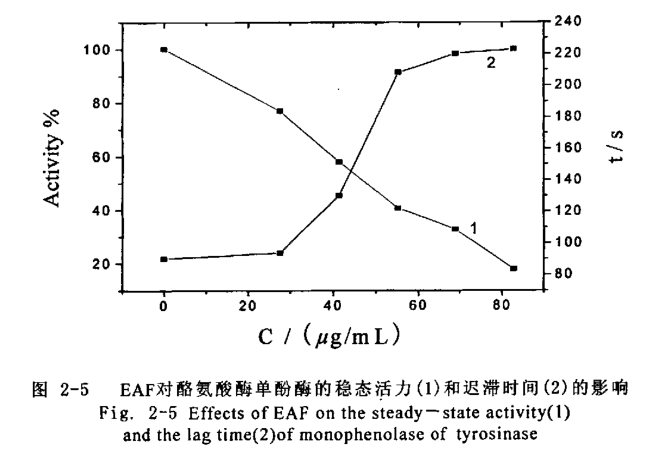
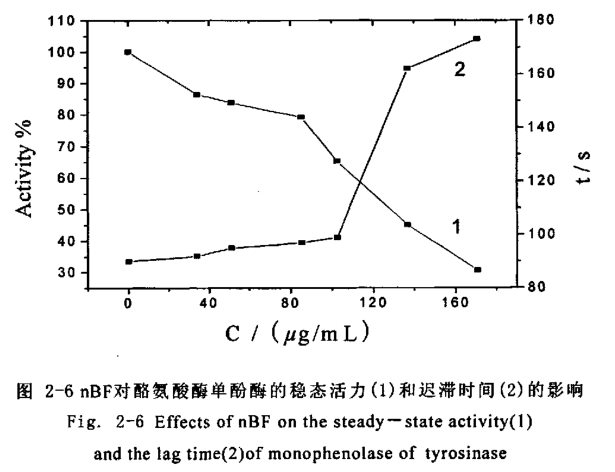
82.1%(图2-5线1)、使迟滞时间从78S延长到223S(图2-5线2);170.8g/mL的nBF部分使得酶的稳态活力下降了69.4%(图2-6线1)、使迟滞时间从78S延长到173S(图2-6线2)。
2.4.4 对酪氨酸酶双酚酶活力的影响
以L-DOPA为底物,测试各部分对酪氨酸酶双酚酶活力的影响,结果见表2-3。
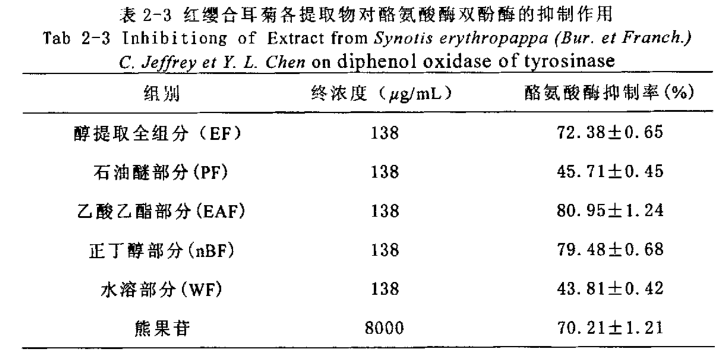
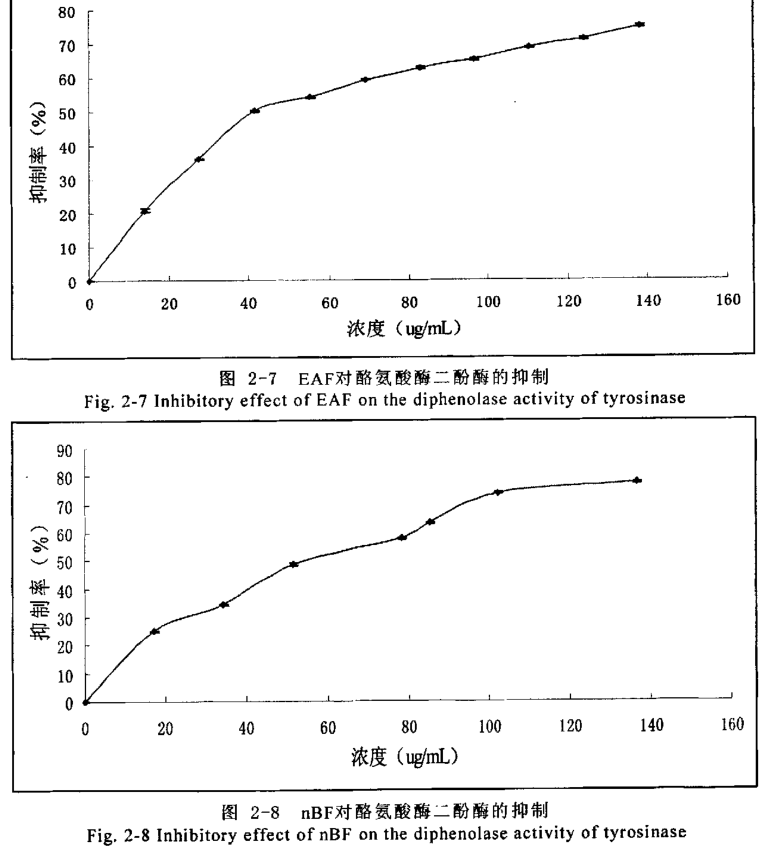
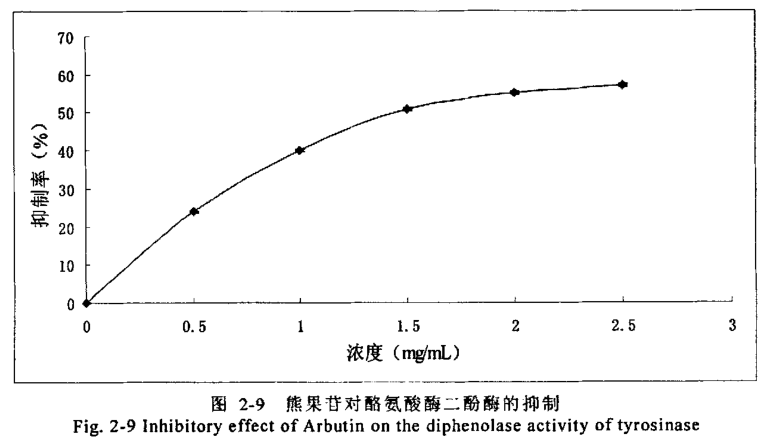
实验中1384g/m醇提取物、乙酸乙酯、正丁醇部分对酪氨酸酶抑制率分别为72.38%、80.95%、79.48%均超过8.0mg/mL 熊果苷的 70.21%,而石油醚及水溶部分对酶的抑制活性较弱,说明西藏红缨合耳菊抑制酪氨酸酶双酚酶的主要有效组分集中在EAF、BF部分。进一步研究EAF、nBF部分对酪氨酸酶双酶活力抑制能力发现抑制率随着提取物浓度的增大而增大,ICS0分别为41.2、59.6μg/mL(见图7、图8)。比熊果苷抑制双酚酶活性的IC5o值 1.44 mg/mL低得多(见图2-9)。
2.4.5对酪氨酸酶抑制类型
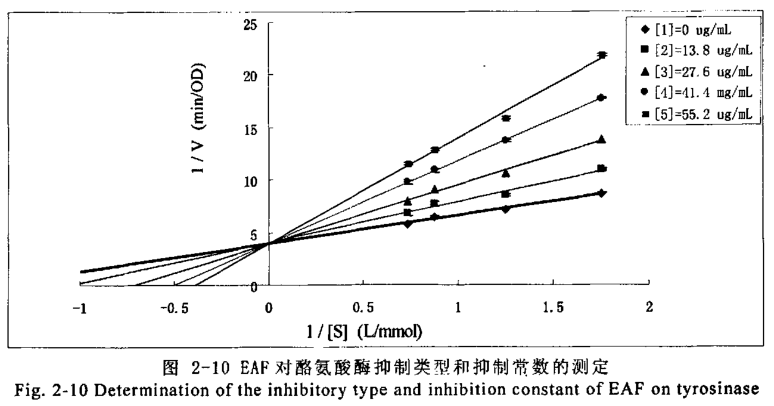
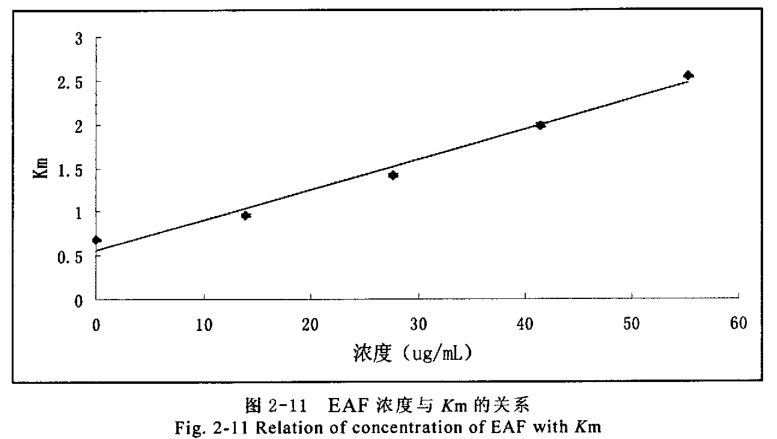
进一步研究EAF、nBF部分对酪氨酸酶二酚酶抑制作用类型,在测活体系中,固定酶的浓度,改变底物L-DOPA的浓度,测定不同浓度效应物对酶活力的影响,以 Lineweaver-Burk双倒数作图判断抑制类型。乙酸乙酯部分双倒数图(见图 2-10)得到一组纵轴截距不变的直线,表明其抑制类型为竞争性类型。以不同浓度乙酸乙酯部分测定的Km对抑制剂浓度作图可得一条直线(见图2-11),从直线的斜率求得抑制常数(K;)为19.7 g/mL。
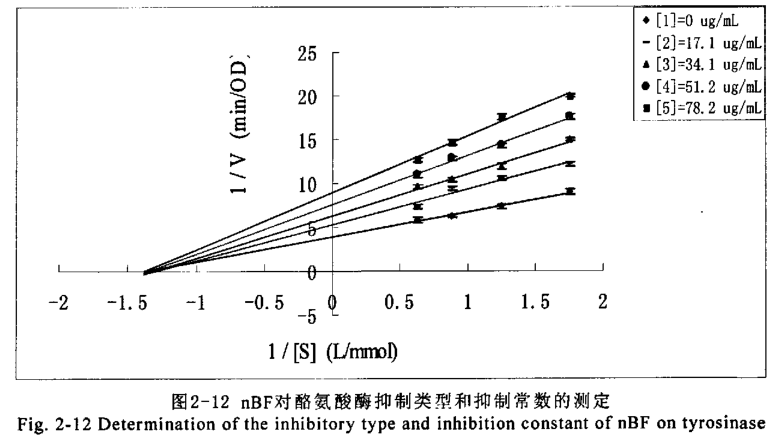
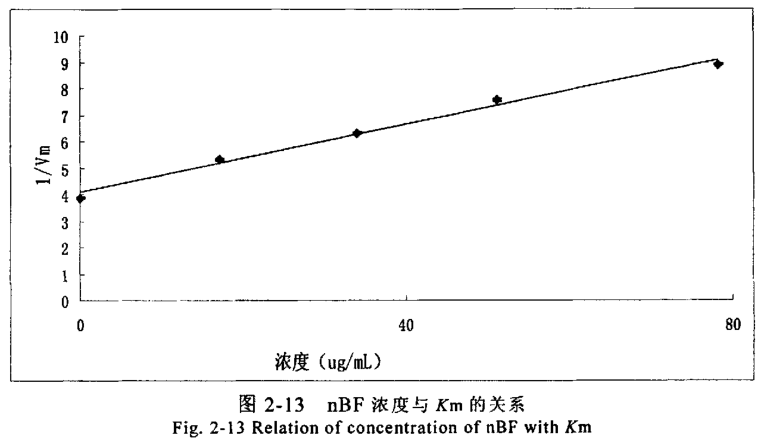
正丁醇部分双倒数图(见图2-12)得到一组横轴截距不变的直线,表明其抑制类型为非竞争性类型。以不同浓度正丁醇部分测定的1/Vmax对抑制剂度作图可得一条直线(图2-13),从直线的斜率求得抑制常数(K)为60.7g/mL 。
2.5 讨论
酪氨酸酶为黑素生物合成的限速酶,控制其活力可控制黑素生成量。酪氨酸酶在黑色素的生物合成过程中起着关键作用,该酶活性过高会导致色斑及黑色素瘤的形成,酪氨酸酶是合成黑色素的关键酶。因此,在美自化妆品中添加能抑制酪氨酸酶活性的美白剂,可以通过抑制酪氨酸酶活性直接抑制黑色素的生成,从而达到美白肌肤的目的。早期研究发现,熊果苷对酪氨酸酶活性有明显抑制作用本研究结果表明熊果苷浓度在一定范围内,酪氨酶活性随其浓度增加而降低,表现出较强的对酪氨酸酶的抑制作用,与前人研究结果一致。因此本实验选择熊果苷作为阳性对照物,观察红缨合耳菊提取物对酪氨酸酶的抑制作用,为寻找新的美白功效的化妆品原料提供实验依据。从上面两种抑制剂相比较来看,红缨合耳菊提取物对酪氨酸酶的抑制效果远优于熊果苷。并且可以看出红缨合耳菊提取物对酪氨酸酶的抑制效果非常明显。红缨合耳菊的EAF、nBF部分对酪氨酸酶的单酚酶的抑制效果明显优于熊果苷,这两部分的半数抑制率IC5分别可达到57.8、140μg/mL;且延迟时间较长,82.8g/mLEAF部分使得酶的稳态活力下降了82.1%、使迟滞时间从78S延长到223S:170.8g/mL的nBF部分使得酶的稳态活力下降了69.4%、使迟滞时间从78S延长到173S。在这个过程中不仅可以有效的抑制酪氨酸酶单酚酶的活性,并且能延迟黑色素的最初反应进程。对酪氨酸酶双酚酶也有明显的抑制作用,随提取物浓度的增加,酪氨酸酶的活性逐渐降低,EAF、nBF部分的IC50分别为41.2、59.6g/mL其效果远优于熊果苷(IC50值为1.44mg/mL),与熊果苷比较,EAF、nBF部分起到了与熊果苷相似的抑制作用,且相关关系分析说明EAF、nBF部分浓度与其对酪氨酸酶活性抑制率之间存在正相关关系。抑制剂对酶的抑制作用主要表现为两个类型不可逆抑制和可逆抑制。从红缨合耳菊提物对酪氨酸酶的抑制作用的实验结果可以表明,红缨合耳菊提取物对酪氨酸酶的抑制作用明显的表现为可逆抑制。而可逆抑制又分为竞争性抑制,非竞争性抑制,反竞争抑制及混合性抑制等类型。因此本实验在验证了红缨合耳菊提物对酪氨酸酶的抑制作用表现为可逆抑制后,进一步作了抑制作用的动力学分析。从动力学实验分析中可以初步得出结论,EAF部分对酪氨酸酶的抑制效果主要表现为竞争性抑制,抑制常数(K)为19.7g/mL;而nBF部分对酪氨酸酶的抑制作用主要表现为非竞争性抑制抑制常数(K;)为60.7g/mL。由于红缨合耳菊提取物是粗提产品,成分复杂,也不排除有其它抑制类型的可能性,因此该结论只能是初步的,只有将有效成分提纯后才能进-步测出其有效成分对酪氨酸酶的抑制类型。与常用的化妆品添加剂熊果苷相比较我们会发现其体外酪氨酸酶抑制效果非常理想,美自效果几乎是熊果苷的40倍,而且这是天然植物的提取物,属于纯天然的美白化妆品添加剂。红缨合耳菊提取物对酪氨酸酶的抑制作用为预防和治疗各种色素病及黑色素瘤开辟了一条新途径,在化妆品行业和临床医学应用方面具有开发价值,为进一步对有效成分的提纯、开发和利用打下基础。
2.6本章小结
1.用石油醚、乙酸乙酯、正丁醇将红缨合耳菊提取物依次进行萃取,初步对其进行分离提取,得到四个不同极性段的物质。
2.测定了红缨合耳菊提取物对酪氨酸酶单酚酶的影响,研究发现乙酸乙酯及正丁醇萃取部分对单酚酶有强的抑制作用,半数抑制率IC5分别为57.8、140ug/mL。
3.测定了乙酸乙酯及正丁醇萃取部分对单酚酶的延迟作用,82.8g/mLEAF部分使得酶的稳态活力下降了.82.1%、使迟滞时间从78S延长到223S;170.8Hg/mL的BF部分使得酶的稳态活力下降了69.4%、使迟滞时间从78S延长到173 S
4.测定了测定了红缨合耳菊提取物对酪氨酸酶双酚酶的影响,研究发现乙酸乙酯及正丁醇萃取部分对单酚酶有强的抑制作用,半数抑制率ICs0分别为41.259.6 g/mL.
5.研究了乙酸乙酯及正丁醇萃取部分对双酚酶的抑制作用类型,发现EAF部分对二酚酶的抑制作用表现为可逆竞争性抑制类型,抑制常数为19.7g/mL;nBF部分对二酚酶抑制作用表现为可逆非竞争性抑制类型,抑制常数为60.7ug/mL。
未完待续……

- 星期一, 17 6月 2024
西藏红缨合耳菊提取物的美白机理研究(一)
摘 要
西藏红缨合耳菊(Synotis erythropappa (Bur.et Franch)C. Jeffrey et Y. L. Chen)为菊科(Compositae)植物,属西藏特有植物。产于西藏东南部,西藏当地女性将红缨合耳菊捣碎、烧成灰等后,敷在皮肤表面用于皮肤保养及紫外线防护。黑色素的大量产生是皮肤变黑的重要原因,人体中酪氨酸酶是催化酪氨酸形成多巴,以及多巴形成多巴醌,并最终产生黑色素的关键酶。羟自由基是人体内产生的不稳定的且具有强氧化性的物质,与人体的衰老有密切的联系,氧自由基同样对人体的衰老有密切关系,同时它也在黑色素的形成过程中起到氧化的作用。当自由基大量产生,又得不到有效的清除时,会导致机体组织不断老化。
本文通过研究红缨合耳菊提取物的美白机理,包括红缨合耳菊提取物对酪氨酸酶的抑制作用、B16细胞的影响、自由基清除作用等,探讨了红缨合耳菊在美白方面的功效。取得的结果如下:
一、以酪氨酸为底物,探讨红缨合耳菊提取物酪氨酸酶单酚酶的抑制效果结果表明红缨合耳菊提取物的乙酸乙酯及正丁醇萃取部分有较强的抑制能力,对酪氨酸酶单酚酶的半数抑制浓度IC50分别为57.8、140ug/mL。并能使抑制过程产生延迟作用。
二、以多巴为底物探讨红缨合耳菊提取物酪氨酸酶双酚酶的抑制效果。结果表明红缨合耳菊提取物的乙酸乙酯及正丁醇萃取部分有较强的抑制能力,对双酚酶的半数抑制浓度IC50分别为41.2、59.6ug/mL。通过动力学实验得出抑制类型分别为竞争性抑制以及非竞争性抑制。
三、探讨了红缨合耳菊提取物对B16细胞的影响,结果表明红缨合耳菊提取物对细胞形态和生长均有一定的抑制作用,其中以乙酸乙酯萃取部分最大320ug/mL时细胞生长抑制率可达到65.67%,而正丁醇萃取部分及水溶部分仅为10%左右。
四、红缨合耳菊提取物在抗氧化方面的研究,探讨红缨合耳菊提取物对DPPH和氧自由基的清除作用量。对羟自由基的清除作用在一定程度上可以与抗坏血酸相媲美。乙酸乙酯、正丁醇萃取部分半数清除率IC50分别为2.51、5.12ug/mL与抗坏血酸的ICso值2.42μg/mL相差不多,对氧自由基的半数抑制浓度IC50分为0.27、0.39 mg/mL.
上述实验证明红缨合耳菊提取物具有抑制酪氨酸酶单酚酶及双酚酶的作用对细胞有一定的毒性,此外还具有清除自由基、抗氧化损伤、抗衰老的双重功效有望用于美白护肤和抗衰老型化妆品中。
关键词:红缨合耳菊;酪氨酸酶;B16黑色素瘤细胞;自由基
Abstract
Synotis erythropappa (Bur.et Franch.)C, Jeffrey et Y.L. Chen is Compositae plant, as a natural plant of Tibet. They mainly product in east-nouth of Tibet. The females apple the triturate or ash of them to cure skin disease, Also to avid eultraviolet radiation. As we known, the product of melanin is responsible for the process of skin blackening. Besides, tyrosinase is a key enzyme which can catalyze tyrosine to L-DOPA, and catalyze L-DOPA to dioxyphenylalanine quinine.
Free radicals, a matter produced in vivo, which is close connection with ageing.is instable but powerful in oxidation, If plenty of the free radicals produced with out efficient cleaning, the prganism will be ageing uninterrupt, This paper do some research on the effect of the extract of Synotis erythropappa (Bur. et Franch.)C Jeffrey et Y,L. Chen on the cosmetology,Bl6 cells and antioxygen, From the rsearch of the effect on the inhibition ratio of the tyrosinase and the cleaning of freradicals, we get the following results:
The research of water extract of Synotis erythropappa (Bur. et Franch.)C. Jeffrey et Y.L. Chen on monophenol oxidase of tyrosinase. We discover that the four factions extracted all have inhibitory activities on tyrosinase, inhibitory activity of ethyl acetate and n-butanol fraction are higher than others, concentration that resultsin 50% activity(ICso) lost is 57.8、140 μg/mL, Also they Can extend the lag of the action time of monophenol oxidase.
The research of water extract of Synotis erythropappa (Bur. et Franch.)C Jefrey et Y L. Chen on diphenol oxidase of tyrosinase. We discover that the four fractions extracted all have inhibitory activities on tyrosinase, inhibitory activity of ethyl acetate and n-butanol fraction are higher than others, concentration that resultsin 50% activity(ICso) lost is 41l.2、59.6 μg/mL, The inhibition kinetics analyzed by Hnewaver-Burk plots showed that ethyl acetate faction is a competitive type inhibitor, and the inhibition constants for free enzyme(K¡) was determined to be19.7μg/mL. n-butanol fraction is a uncompetitive type inhibitor, and the inhibition constants for free enzyme(K¡) was determined to be 60.7 μg/mL.
The research of extract from Synotis erythropappa(Bur. et Franch.)C. Jeffrey et Y,L. Chen on Bl6 cells. We discover that the four fractions extracted all have inhibitory activities on B16 cells, inhibitory activity of ethyl acetate fractionare higher than others, ICso is 65.67%.
The research of extract of Synotis erythropappa (Bur. et Franch.) C. Jeffreyet Y, L. Chen on free radicals. We discover that the four fractions extracted all haveinhibitory activities on free radicals, inhibitory activity of ethyl acetate and n-butanol fraction are higher than others, IC50 is 2.51、5.12 g/ml on DPPH and 0.27、0.39mg/mL on oxygen free radicals.
The above-mentioned research demonstrates that Synotis erythropappa (Bur. etFranch,)C, Jeffrey et Y,L. Chen has the effect on skin whitening anf anti-ageing. Soit is promising be used in skin protection cosmetics.
Key word: Synotis erythropappa (Bur. et Franch.)C. Jeffrey et Y. L. Chen; tyrosinase: Bl6 cell; free radicals.

- 星期五, 14 6月 2024
光声电治疗术后皮肤黏膜屏障修复专家共识
中华医学会医学美容学会激光美容学组,中华医学会皮肤性病学会美容激光学组
[关键词】 皮肤黏膜修复,光声电治疗术后;共识
[中图分类号】 R751.05[文献标识码】Bdoi:10.16761/i.cnki.1000-4963.2019.05.019
[文章编号]1000-4963 2019)05-0319-04