A.Giaccari1 · G. Gliozzo1 · G. Ciccarelli1 · G. Di Giuseppe1 · C. Castellano2 · S. Cum3 · L. Delle Monache4,13 · M. Gallo5 ·M.Lastretti6 · G. Medea7 · M. Monesi8 · R. Napoli9 · B. Pintaudi10 · E. Succurro11 · G. Turchetti
Received: 9 January 2026 / Accepted: 17 March 2026 © The Author(s) 2026
Abstract
Background and aims Although continuous glucose monitoring (CGM) devices are now standard of care among Type 1 diabetes patients, they are still relatively underutilized in Type 2 diabetes (T2D), particularly in those patients not treated with insulin. Widespread adoption continues to be hindered by a combination of factors. Chief among these is the scarcity of long-term, large-scale clinical trials demonstrating the benefits of the use of CGM in T2D. This meta-analysis aimed to address this gap by comparing CGM with self-blood glucose monitoring (SBMG), with primary outcomes of HbA1c and time in range (TIR) in insulin-treated and non-insulin-treated TD2 patients.
Methods and results Following the stringent rules mandated by our National Health Service (which requires a panel com-posed of all stakeholders involved in diabetes treatment, and includes PICO, GRADE, AGREE, and meta-analyses), we performed a systematic review of RCTs that enrolled two groups of individuals with T2D, those treated with insulin (includ-ing basal and basal-bolus regimens), and those receiving treatments other than insulin. All included trials compared CGM with structured blood glucose monitoring (SBGM) with glycated hemoglobin (HbA1c) as the main endpoint. Based on the strength and consistency of the evidence, the panel issued a strong recommendation in favor of CGM for individuals with T2D treated with insulin (including those on basal insulin alone) and for individuals with T2D not treated with insulin, par-ticularly for those with glycated hemoglobin levels≥7%. From a pharmacoeconomic perspective, outcomes were positive in both patient groups.
Conclusion CGM represents a clinically effective and cost-efficient approach to optimizing glycemic control in T2D, becom-ing mandatory among individuals on insulin therapy. Our findings support a shift in clinical practice toward the more widespread use of CGM in T2D, with regulatory frameworks and reimbursement policies needing to adapt accordingly.
Keywords CGM · Type 2 Diabetes · Metanalysis · PICO · GRADE · Guidelines
Communicated by Massimo Federici, M.D.
A. Giaccari 该Email地址已收到反垃圾邮件插件保护。要显示它您需要在浏览器中启用JavaScript。
1 Center for Endocrine and Metabolic Diseases, Fondazione Policlinico Universitario A. Gemelli IRCCS and Università Cattolica del Sacro Cuore, Rome, Italy
2 Azienda USL of Modena, Sassuolo Hospital, Sassuolo, Italy
3 Diabetes and Diabetic Foot Care Unit, ASUGI, Monfalcone, Italy
4 National Board Member of FAND (Italian Association for the Rights of Diabetic People), Roma, Italy
5 Department of Endocrinology and Metabolic Diseases, AO SS. Antonio e Biagio e Cesare Arrigo, Alessandria, Italy
6 Order of Psychologists of Lazio, Rome, Italy
7 Italian Society of General Medicine (SIMG), Florence, Italy
8 Territorial Diabetology Unit, AUSL Ferrara, Ferrara, Italy
9 Department of Translational Medical Sciences, University of Naples Federico II, Naples, Italy
10 Diabetes Unit, Niguarda Cà Granda Hospital, Milan, Italy
11 Department of Medical and Surgical Sciences, Magna Graecia University, Catanzaro, Italy
12 Institute of Management, Scuola Superiore Sant’Anna, Pisa, Italy
13 Patient Advocacy Lab, ALTEMS – Università Cattolica del Sacro Cuore, Rome, Italy
版权归中华医学会所有。
未经授权,不得转载、摘编本刊文章。
引用本文:简喜超, 简扬, 邓呈亮. 2025版《中国糖尿病足防治实践指南》解读[J]. 中华医学美学美容杂志, 2026, 32(2): 99-103. DOI: 10.3760/cma.j.cn114657-20251215-00266.
通信作者:邓呈亮,Email:该Email地址已收到反垃圾邮件插件保护。要显示它您需要在浏览器中启用JavaScript。
Angelica Dessì, Roberta Pintus, Vassilios Fanos and Alice Bosco *
Neonatal Intensive Care Unit, Department of Surgical Sciences, University of Cagliari, AOU Cagliari, 09124 Cagliari, Italy; 该Email地址已收到反垃圾邮件插件保护。要显示它您需要在浏览器中启用JavaScript。 (A.D.); 该Email地址已收到反垃圾邮件插件保护。要显示它您需要在浏览器中启用JavaScript。 (R.P.); 该Email地址已收到反垃圾邮件插件保护。要显示它您需要在浏览器中启用JavaScript。 (V.F.) * Correspondence: 该Email地址已收到反垃圾邮件插件保护。要显示它您需要在浏览器中启用JavaScript。
Citation: Dessì, A.; Pintus, R.; Fanos, V.; Bosco, A. Integrative Multiomics Approach to Skin: The Sinergy between Individualised Medicine and Futuristic Precision Skin Care?
Metabolites 2024, 14, 157. https:// doi.org/10.3390/metabo14030157
Academic Editors: Eleftherios Panteris and Olga Deda
Received: 1 February 2024
Revised: 1 March 2024
Accepted: 4 March 2024
Published: 7 March 2024
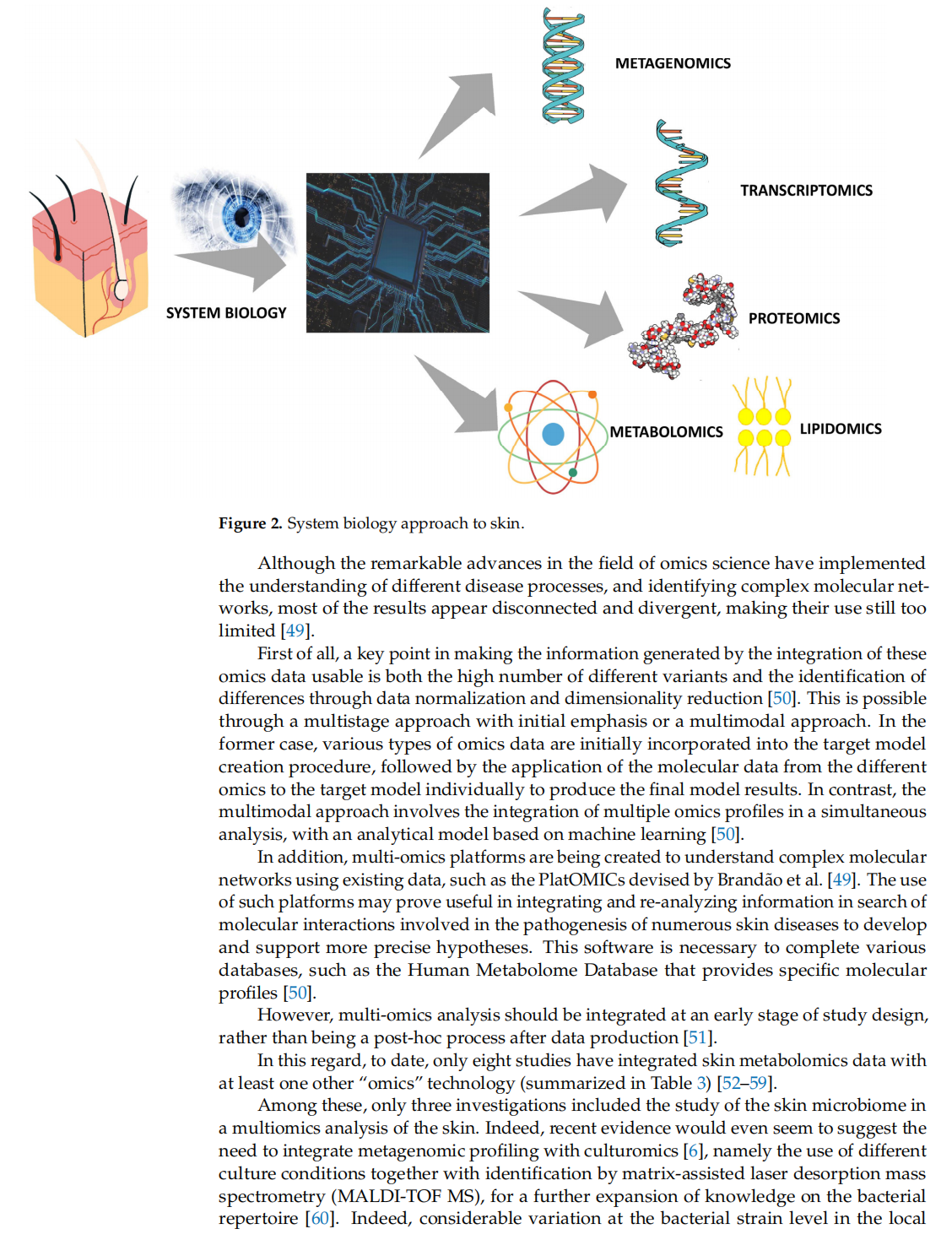
Abstract: The skin is a complex ecosystem colonized by millions of microorganisms, the skin microbiota, which are crucial in regulating not only the physiological functions of the skin but also the metabolic changes underlying the onset of skin diseases. The high microbial colonization together with a low diversity at the phylum level and a high diversity at the species level of the skin is very similar to that of the gastrointestinal tract. Moreover, there is an important communication pathway along the gut–brain–skin axis, especially associated with the modulation of neurotransmitters by the microbiota. Therefore, it is evident that the high complexity of the skin system, due not only to the genetics of the host but also to the interaction of the host with resident microbes and between microbe and microbe, requires a multi-omics approach to be deeply understood. Therefore, an integrated analysis, with high-throughput technologies, of the consequences of microbial interaction with the host through the study of gene expression (genomics and metagenomics), transcription (transcriptomics and meta-transcriptomics), and protein production (proteomics and meta-proteomics) and metabolite formation (metabolomics and lipidomics) would be useful. Although to date very few studies have integrated skin metabolomics data with at least one other ‘omics’ technology, in the future, this approach will be able to provide simple and fast tests that can be routinely applied in both clinical and cosmetic settings for the identification of numerous skin diseases and conditions. It will also be possible to create large archives of multi-omics data that can predict individual responses to pharmacological treatments and the efficacy of different cosmetic products on individual subjects by means of specific allotypes, with a view to increasingly tailor-made medicine. In this review, after analyzing the complexity of the skin ecosystem, we have highlighted the usefulness of this emerging integrated omics approach for the analysis of skin problems, starting with one of the latest ‘omics’ sciences, metabolomics, which can photograph the expression of the genome during its interaction with the environment.
Keywords: skinomics; multiomics; precision skin care; skin metabolome; system biology
This article is excerpted from the Metabolites 2024, 14, 157 by Wound World.

伤口世界平台生态圈,以“关爱人间所有伤口患者”为愿景,连接、整合和拓展线上和线下的管理慢性伤口的资源,倡导远程、就近和居家管理慢性伤口,解决伤口专家的碎片化时间的价值创造、诊疗经验的裂变复制、和患者的就近、居家和低成本管理慢性伤口的问题。
2019广东省医疗行业协会伤口管理分会年会
扫一扫了解详情:
任何关于疾病的建议都不能替代执业医师的面对面诊断。所有门诊时间仅供参考,最终以医院当日公布为准。
网友、医生言论仅代表其个人观点,不代表本站同意其说法,请谨慎参阅,本站不承担由此引起的法律责任。