There is a significant concern in the Caribbean about severe lowerextremity amputations. More specifically, in 2021, Pran and colleagues reported that the average annual major lowerlimb amputation rate in Trinidad & Tobago is about 600 (596.5), with an average daily rate of 1.63 (Pran et al, 2021). This statistic is staggering, considering the Trinidad & Tobago population in 2023 was reported as 1.4 million (The World Factbook, 2023).
One of the leading causes of major lowerextremity amputations is diabetes mellitus and its foot-related complications, which occurred in 91% of the study population. In individuals with diabetes, severe foot infections can be detrimental to the patient’s overall health if left untreated, leading to amputations. Based on estimates from the International Diabetes Federation, the prevalence of diabetes in Trinidad and Tobago ranges from 11.7% to 12.5% (International Diabetes Federation, 2023). A typical sequence of events related to an unmanaged or mismanaged wound may lead to limb amputation, which then requires prosthetic appliances, physical and occupational rehabilitation, an assault on a patient’s emotional state requiring them to seek psychological support, and a significant decrease in their quality of life and even death.
Therefore, this study exemplifies the stepwise design of an efficacious wound care management system, the Total Wound Care Solution System® (TWCSS).
Methodology Products evaluated
The TWCSS is a novel design to provide the clinician with the most effective armamentarium in an easy-to-use, self-contained, single-patient use, affordable, clinically efficacious wound care kit to address most wound challenges. The breadth of products in the system includes collagen particles (Simpurity™ Collagen), hypochlorous solution (Simpurity DermaPure Antimicrobial Wound and Skin Cleanser), sterile gauze sponges (Simpurity Gauze Sponges), and sterile bordered gauze sponges (Simpurity Boarded Gauze Sponges). The Simpurity product line is manufactured by Safe-n-Simple LLC in Clarkston, Michigan. The products are cleared by the U.S. Food and Drug Administration to manage diabetic and non-diabetic wounds, Stages II-IV pressure ulcers, ulcers resulting from venous stasis and arterial insufficiency, traumatic wounds, and superficial and surgical wounds, including superficial and partial-thickness burns (excluding full-thickness burns). Noteworthy, collagen particles are newly introduced into the Trinidad & Tobago healthcare system and are approved by the Ministry of Health, Chemistry Food and Drugs Division.
Recommended product application and dressing frequency Product Application
The application of the products follows a stepwise manner. Step 1: This step focuses on the preparation of the wound bed. The wound is adequately debrided if clinically indicated. The debridement type is based on the clinician’s judgment. Step 2: This step is intended to address wound bioburden potential. Spray the Simpurity DermaPure Antimicrobial Wound and Skin Cleanser covering the wound and peri-wound area, and let the cleanser remain for a few minutes. Ensuring the cleanser has dried before proceeding to the next step is unnecessary. Step 3: Sprinkle the Simpurity Collagen particles covering the entire wound bed to a depth of approximately 0.2cm. If the wound has an appreciable level of exudation, double the depth level of the collagen particles to approximately 0.4cm. Step 4: Cover with Simpurity Boarded Gauze Sponges to help maintain the integrity of the wound area. When showering, advise the patient not to expose the wound dressing to excessive water.
Dressing frequency
The frequency of subsequent dressing changes averages every 3-4 days. More frequent dressing changes may be necessary for moderate to heavy wound exudation.
Selection criteria
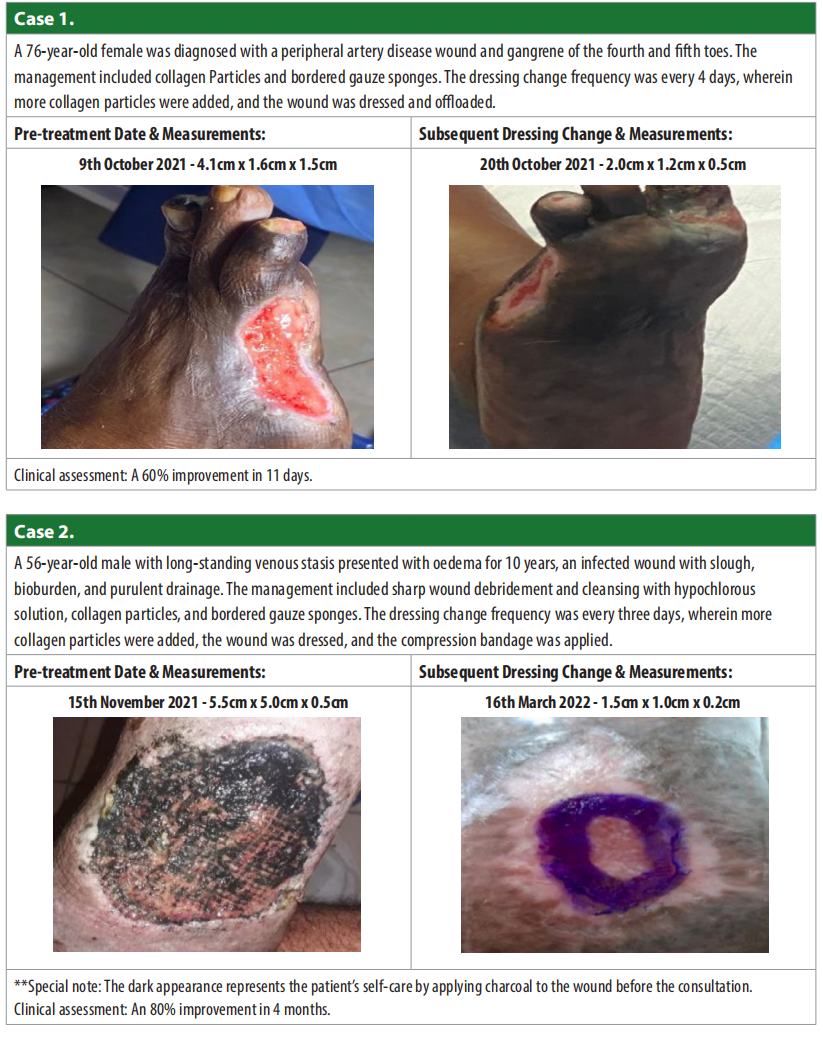
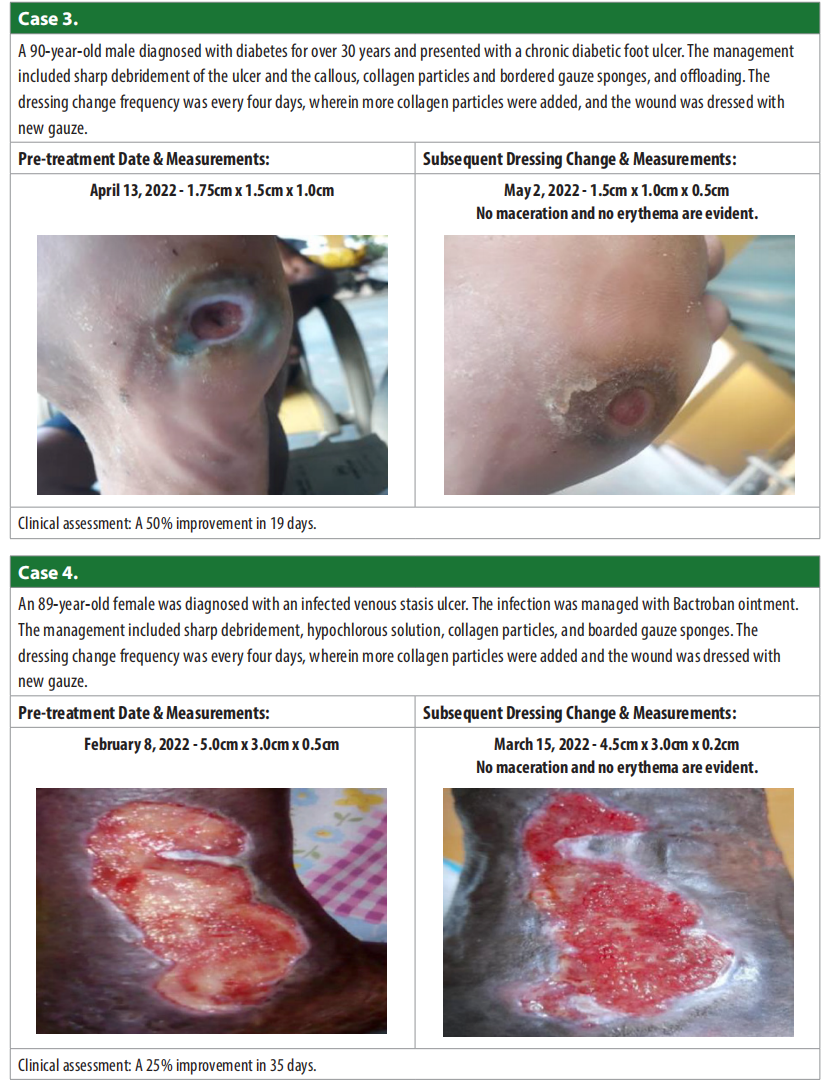
Four patients were retrospectively selected from diverse socioeconomic backgrounds utilising the following criteria.
■ Inclusion criteria 1) Chronic recalcitrant wounds 2) Infected wounds 3) Patients with
■ Exclusion criteria 1) Patients who were deceased prior to wound closure 2) Patients with osteomyelitis 3) Patients who were non-compliant with treatment.
Discussion
Evidence-based medicine (EBM), whose philosophical origins extend back to mid-19th century Paris and earlier, is the conscientious, explicit, and judicious use of current best evidence in making decisions about the care of individual patients (Sackett, 1997). Applying the systematic approach of EBM to address the lower-limb amputation epidemic in Trinidad & Tobago, which is multifactorial, and one of the contributing factors is nonhealing wounds, which led to the creation and design of the TWCSS. The TWCSS offers patients two main advantages. First, it is easy to use, self-contained, single-patient-use and affordable. Second, the products are clinically efficacious — the hypochlorous solution and the collagen particles.
Various biofilms have been shown to impair the physiologic processes underlying wound healing, thus promoting the development of chronic wounds. The hypochlorous solution demonstrates excellent bacterial and fungal biofilm activity compared to other topical antimicrobial agents. Hypochlorous acid-based wound solutions exert potent biofilm killingactivity (Harriott et al, 2019).
Collagen, a vital component of the extracellular matrix, plays a critical role in regulating the phases of wound healing either in its native fibrillar conformation or as soluble components in the wound milieu. Collagen has been identified as having multiple functions in the healing process, which is involved with haemostasis, autolysis and angiogenesis, and is chemotactic to fibroblasts, to name a few (Newman et al, 2008).
Conclusions and recommendations
As demonstrated in this limited case report, by utilising the products in the Total Wound Care Solution System, the system can aid wound healing of chronic lower-extremity wounds, which can contribute to the reduction of limb, resulting in limb salvage. This study was designed to act as a pilot for additional investigation and as a basis for future studies to evaluate this product line to design a more strategic and precise future longitudinal study. The complex process of wound healing has been extensively investigated and is understood to be multifaceted. Each component is considered critical to the process, so we acknowledge that these products alone did not promote chronic wound healing. Variables such as body weight, circulation and perfusion, nutrition, and management of comorbidities contribute to a positive patient outcome in wound care for these patients.
Declaration of interest
Dr Larry G. Baratta is a compensated consultant to Realm Labs, LLC and Safe-n-Simple, LLC. Ms. Yvonne Braithwaite Superville reports no conflict of interest.
References
1. Harriott MM, Bhindi N, Kassis S et al (2019) Comparative antimicrobial activity of commercial wound care solutions on bacterial and fungal biofilms. Ann Plast Surg 83(4): 404–10
2. International Diabetes Federation (2023) Trinidad and Tobago. Brussels: International Diabetes Federation. Available at: https://idf.org/our-network/regionsmembers/north-america-and-caribbean/members/73-trinidad-and-tobago.html (accessed 26.09.2023)
3. Newman MI, Baratta LG, Swartz K (2008) Activated, type I collagen (CellerateRx) and its effectiveness in healing recalcitrant diabetic wounds. Adv Skin Wound Care 21(8): 370–4
4. Pran L, Harnanan D, Baijoo S et al (2021) Major lower limb amputations: recognizing pitfalls. Cureus 13(8): e16972
5. Sackett DL (1997) Evidence-based medicine. Semin Perinatol 21(1): 3–5
6. The World Factbook (2023) Explore All Countries — Trinidad and Tobago. Central America and the Caribbean. Central Intelligence Agency. Available at: https://www.cia.gov/ the-world-factbook/countries/trinidad-and-tobago/ (accessed: 26.09.2023)
This article is excerped from the Wounds International 2023 | Vol 14 Issue 3 by Wound World.