本文转载于 Experimental Dermatology published by John Wiley & Sons Ltd.,不代表本网站赞同其观点和对其真实性负责,我们只作于阅读分享,非商业用途,如若侵权,请告知删除。
Xiaolong A. Zhou1 | Michael B. Burns2 | Ziyou Ren1 | Elise Stagaman2 | Stefan J. Green3 | Lok Yiu Ashley Wu3 |
Lynna Yang1 | Stephanie Rangel1 | Lydia Rabbaa1 | Amy S. Paller1
1Department of Dermatology, Northwestern University, Feinberg School of Medicine, Chicago, Illinois, USA | 2Department of Biology, Loyola University
Chicago, Chicago, Illinois, USA | 3Genomics and Microbiome Core Facility, Rush University Medical Center, Chicago, Illinois, USA
Correspondence: Amy S. Paller (该Email地址已收到反垃圾邮件插件保护。要显示它您需要在浏览器中启用JavaScript。)
Received: 6 February 2025 | Revised: 6 June 2025 | Accepted: 3 August 2025
Funding: This work was supported by Applied Pharma Research.
Keywords: acid-oxidising solution | epidermolysis bullosa | hypochlorous acid | microbiome | Staphylococcus aureus | wounds
ABSTRACT
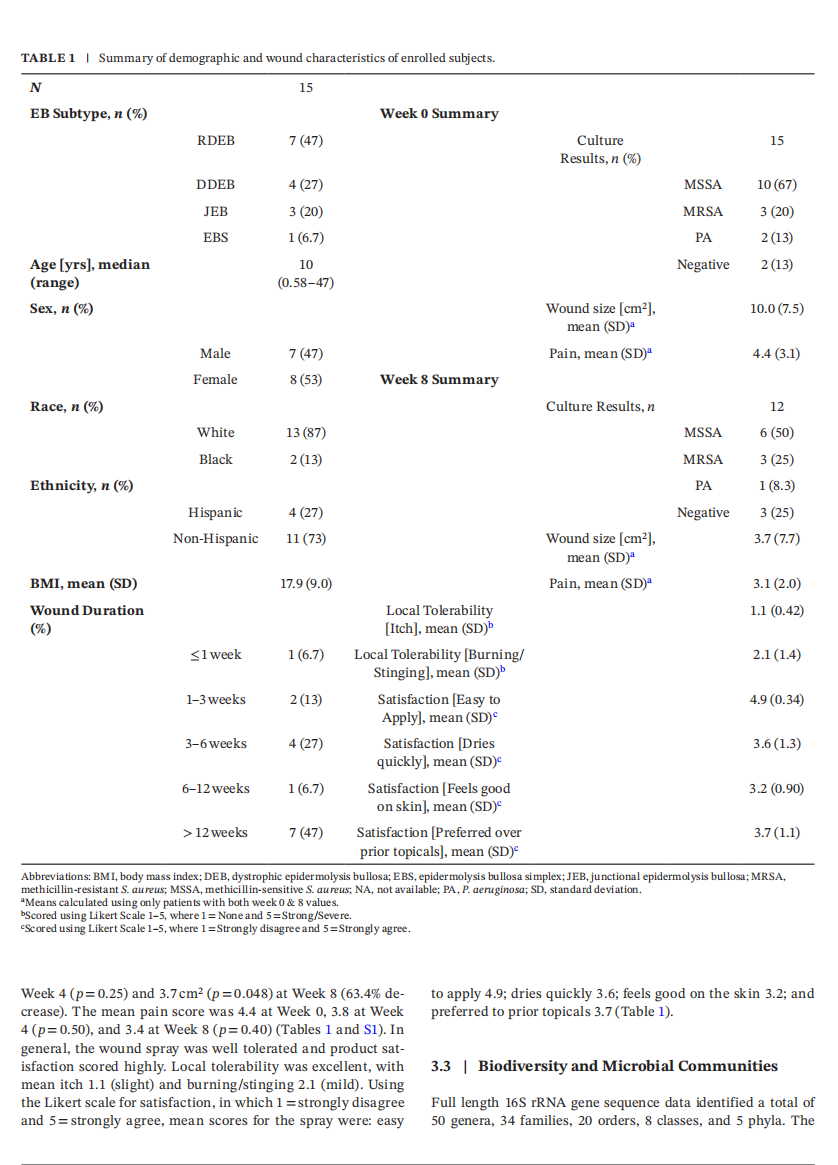
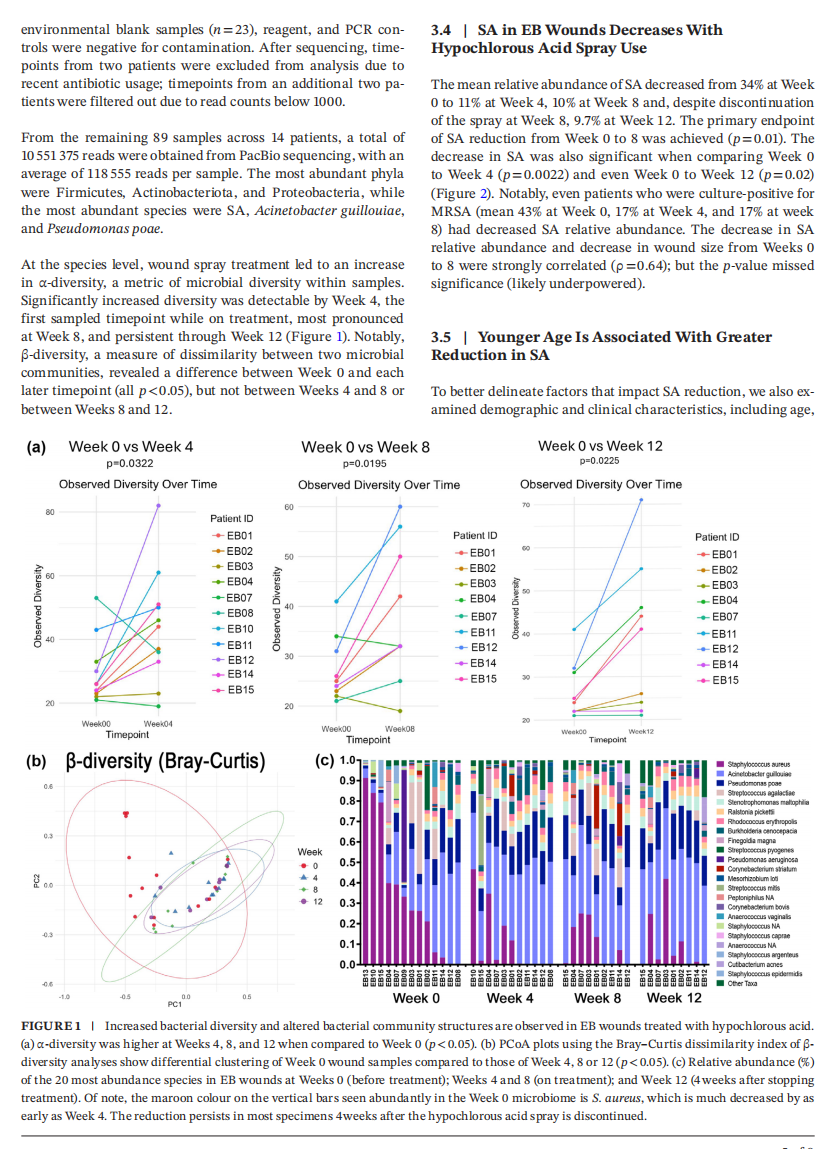
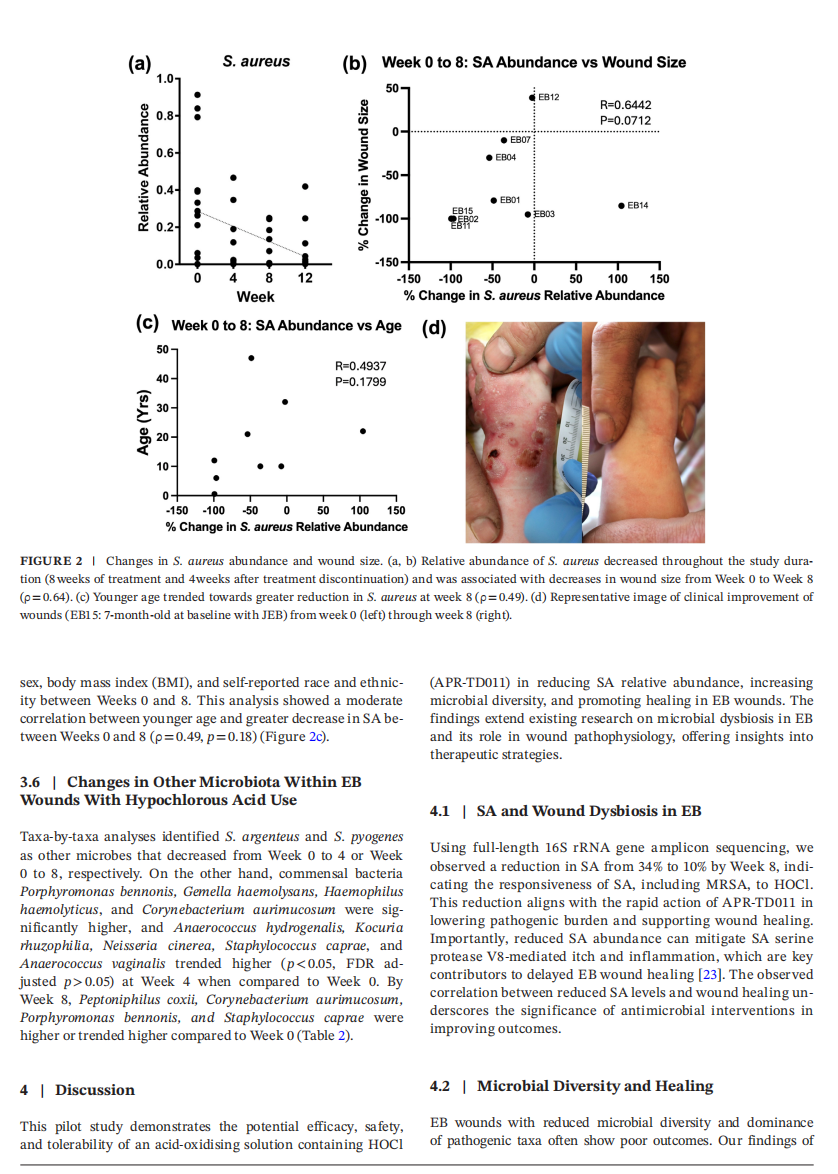
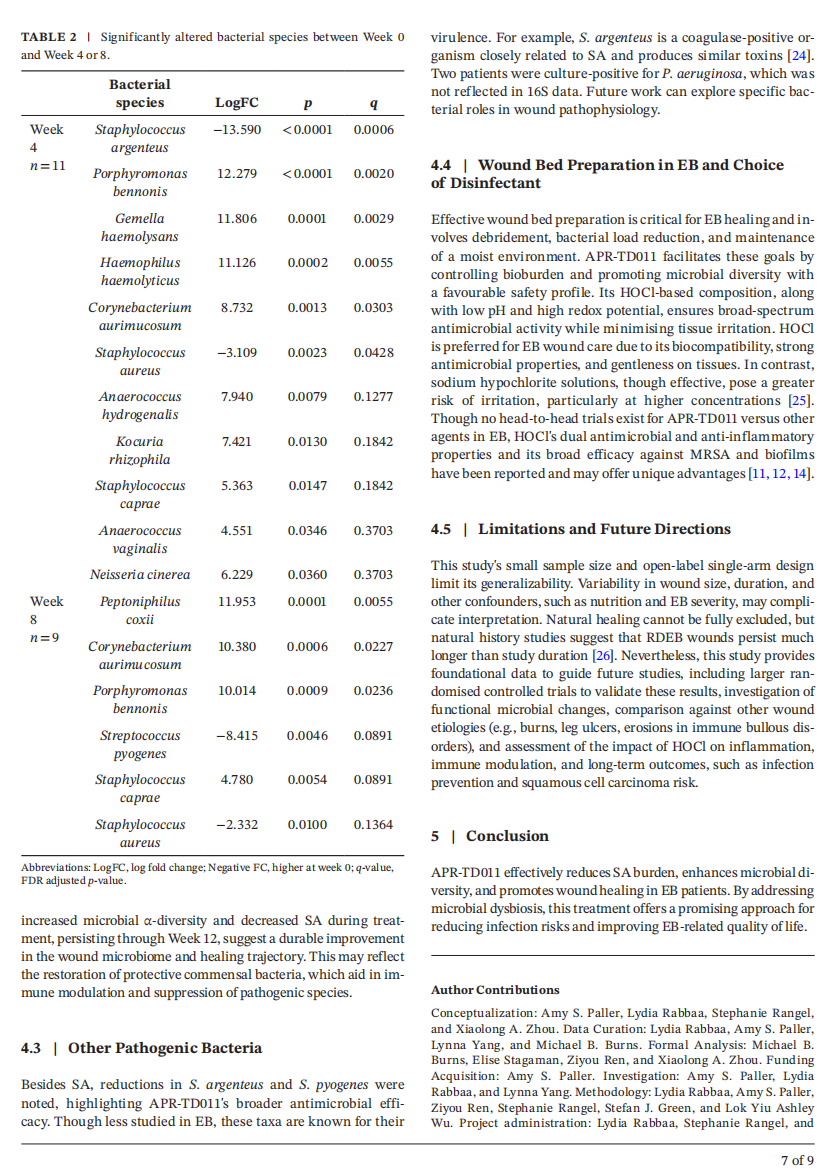
Epidermolysis bullosa (EB) is a group of rare genetic skin disorders characterised by skin fragility and chronic, painful wounds that are highly susceptible to bacterial infection, particularly by Staphylococcus aureus (SA). This study evaluated the efficacy of an acid-oxidising solution containing hypochlorous acid (HOCl) in reducing SA colonisation, promoting wound healing, and restoring a healthier microbiome in EB wounds. In a 12-week open-label pilot study, 15EB patients applied the HOCl-based spray (APR-TD011) daily to chronic wounds for 8weeks, with full-length 16S rRNA sequencing of wound swabs performed before, during, and after treatment. At baseline, 87% of patients were culture-positive for SA, and sequencing revealed that SA had the highest relative abundance (34%), followed by Acinetobacter guillouiae and Pseudomonas poae. SA relative abundance decreased precipitously by Weeks 4 (to 11%) and 8 (primary endpoint; to 10%, p<0.01), and this effect persisted at 4weeks post-treatment (Week 12; to 9.7%), including for methicillin-resistant SA. Concurrently, bacterial diversity increased, and wound sizes diminished in correlation with reduced SA levels (r=0.64). Younger patients exhibited greater SA reduction trends. The treatment was well-tolerated, with minimal adverse effects and high patient satisfaction. This study underscores the role of microbial dysbiosis in EB wounds and highlights HOCl-based solutions as a promising therapy to mitigate pathogenic burden and enhance wound healing.
本文转载于 Experimental Dermatology published by John Wiley & Sons Ltd.,不代表本网站赞同其观点和对其真实性负责,我们只作于阅读分享,非商业用途,如若侵权,请告知删除。